
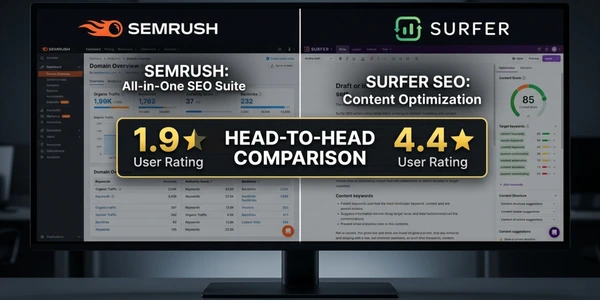
Buying an SEO tool is no longer one decision. Semrush and Ahrefs sell broad research platforms. Surfer, Clearscope, and NeuronWriter focus much more heavily on the content workflow. A cheap content score cannot replace backlink data or site auditing, while an expensive research suite can be overkill if the bottleneck is publishing a better brief.
I compared five tools by the work they replace, the limits attached to the entry plan, the current public price, and how easy the subscription is to understand before checkout. This is an evidence-led guide: I checked official public pricing and product pages on August 30, 2026, but did not create paid accounts, run live campaigns, or test cancellation and support.
The result is less dramatic than most rankings and more useful: Semrush remains the best default for full-stack SEO, Ahrefs is the specialist choice for link research, and content teams should start with Surfer or NeuronWriter instead of paying for a platform they will barely use.
-
#1 SemrushBest all-in-one: keyword research, backlinks, site audit, rank tracking. Read the cancellation terms before you sign up.
-
#2 Surfer SEOBest for content teams: real-time scoring, AI visibility, and 360 documents on the checked entry plan.
-
#3 NeuronWriterBest budget pick: $23/month for 25 analyses, 15,000 AI credits, and five monitored questions.
How I ranked the tools
The ranking uses one shared rubric across all five products: research coverage, workflow fit, price clarity, and exit friction. Research coverage gets the most weight because the default buyer needs keyword, competitor, backlink, audit, and tracking data in one place. Workflow fit asks whether the tool removes the buyer's actual bottleneck. Price clarity includes billing cadence, seats, and meaningful plan limits. Exit friction covers public cancellation, renewal, and usage boundaries rather than relying on a low headline price.
That weighting explains why Semrush can beat cheaper content optimizers in the overall ranking while still losing to them for a narrow publishing workflow. The ranking is a default purchase order, not a claim that one product is best at every SEO task.
Semrush — the best default when one platform must cover the whole job
Semrush combines keyword research, site auditing, backlink analysis, competitor tracking, and rank monitoring in one account. That breadth is what makes it hard to replace. A stack built from specialists can go deeper in one area, but it also creates more subscriptions, handoffs, and limits to manage.
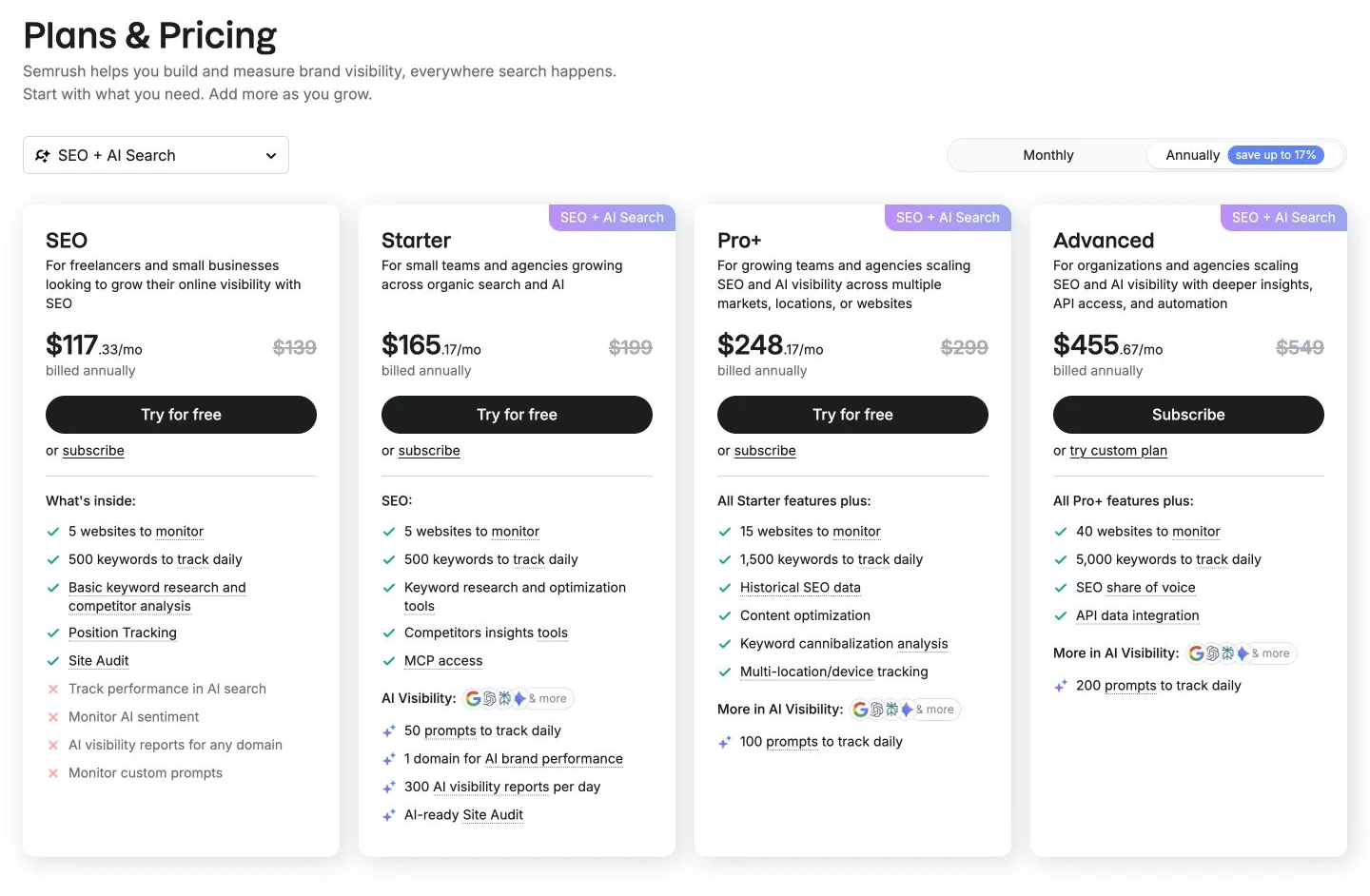
Semrush replaced the old Pro, Guru, and Business ladder on this public pricing surface. The current SEO plan is $139 monthly or $117.33 per month billed annually and includes five websites, 500 keywords tracked daily, keyword and competitor research, Position Tracking, and Site Audit. Starter is $199 monthly or $165.17 on annual billing and adds the AI-search layer, including 50 daily prompts, one brand-performance domain, and 300 AI visibility reports per day. Pro+ is $299 monthly or $248.17 annually; Advanced is $549 monthly or $455.67 annually.
Semrush's own FAQ says buyers can cancel, downgrade, or upgrade at any time unless custom signed terms apply. That is clearer than the old article suggested, but the public Trustpilot score remains poor. I would still set a renewal reminder and verify the cancellation state inside the account. A software suite can be useful and still deserve caution around recurring billing.
Single platform covers keyword research, site auditing, backlinks, and rank tracking without juggling separate tools.
Solo bloggers on tight budgets who only need content optimization, since NeuronWriter does that for $23/month.
Semrush leads because it covers the broadest SEO workflow and publishes the plan ladder clearly; recurring-billing caution is the main drag on the score.
- Single platform for keyword research, site auditing, backlinks, and rank tracking. No juggling 3 separate tools.
- SEO includes 5 monitored websites and 500 keywords tracked daily at $117.33/month on annual billing.
- Starter adds AI-search tracking, MCP access, 50 daily prompts, and 300 AI visibility reports per day.
- The current public page offers a 7-day free start and shows monthly list prices beside annual equivalents.
- The entry SEO plan excludes the AI-search monitoring features shown on Starter and above.
- The broad platform is expensive when the only bottleneck is content optimization.
- Additional users start at $45 per month, so team cost rises beyond the visible base plan.
- Public review scores still justify a renewal reminder even though the official FAQ now says buyers can cancel or change plans at any time.
Best fit: replace several separate SEO subscriptions with one platform. If the work begins and ends inside a content editor, Semrush's breadth becomes expensive overhead.
Ahrefs — the strongest link-research specialist, with tighter usage economics
Ahrefs is built around backlink and competitor research. Site Explorer, referring-domain history, Link Intersect, and Content Explorer make it the clearest specialist in this roundup. If the team's recurring job is finding where competitors earn links and deciding which gaps matter, Ahrefs deserves a closer look than its second-place rank suggests.
The current official ladder is Lite at $129 per month, Standard at $249, Advanced at $449, and Enterprise at $1,499 with an annual commitment. Lite includes five projects, 750 tracked keywords, five tracked AI prompts, 100,000 crawl credits, 1,000 credits, and one user. Ahrefs advertises annual savings of up to 17%, but the checked public view did not expose one universal annual equivalent for every tier.
The usage model matters as much as the plan price. Lite allows two additional users at $40 each and still uses 1,000 monthly credits per user. Standard removes the per-user credit ceiling but moves to $249 before extra seats. Ahrefs also says enabled pay-as-you-go credits and data can trigger automatic charges after plan limits are exceeded.
There is now a useful no-cost distinction: verified website owners can use Ahrefs Free for limited Site Explorer and Site Audit access, while the separate Starter product costs $29 per month. The official FAQ says paid plans can be cancelled from Account Settings and continue until the end of the billing period. That is a better evaluation path than describing Starter as a seven-day trial.
Site Explorer, Link Intersect, referring-domain history, and competitor research keep the workflow centered on link decisions.
Content-first teams that do not need deep link research, since Lite begins at $129 and still uses monthly credits.
Ahrefs earns second place on link and competitor research, but entry credits, paid add-ons, and a narrower default workflow keep it behind Semrush.
- Site Explorer, referring-domain history, and Link Intersect support a focused link-research workflow.
- Keywords Explorer covers Google, YouTube, Amazon, Bing, and more. Useful for multi-channel research.
- Consistent, focused interface with less feature sprawl than Semrush. Helps if you know exactly what you need.
- Lite publishes 750 tracked keywords, 100,000 crawl credits, five AI prompts, and five projects.
- Lite still uses 1,000 monthly credits per user, so active research can encounter usage friction before the month ends.
- Additional users cost $40 on Lite, $60 on Standard, and $80 on Advanced.
- Enabled pay-as-you-go credits and data can create automatic charges after limits are exceeded.
- The strongest value case is backlink research; content-first teams pay for a wider platform than they need.
Choose Ahrefs when backlink and competitor research justifies the subscription. A content bottleneck or another monthly credit ceiling points to a different purchase.
Surfer SEO — a different tool entirely, and that's the point
Surfer SEO is bought for a different job from Semrush or Ahrefs. Its public Content Editor centers the draft, live Content Score, optimization controls, and topic coverage. It is less a broad research platform than a guided workspace for improving a page before publication.
The localized Croatia/EU view checked for this refresh showed Standard at €99 per month billed yearly, Pro at €182, and Peace of Mind at €299. Standard includes 360 content documents, 25 AI prompts refreshed weekly, integrations, Brand Knowledge, and one-click content optimization. Pro keeps 360 documents but adds 50 prompts refreshed daily, five brand workspaces, internal linking, and content-gap features. Regional currency and checkout terms can differ, so buyers outside the EU should verify their own render.
The plan names are still Standard, Pro, and Peace of Mind, but the product is now positioned around both classic content optimization and AI-search visibility. The useful boundary remains unchanged: Surfer can improve the writing and optimization step, but it does not replace a backlink database, full keyword platform, or technical SEO suite.
Content scoring is directional evidence, not a recipe. A high score shows that a draft covers patterns Surfer found in competing pages; it does not prove the draft is accurate, original, or likely to rank. I would use the score to find omissions, then reject any recommendation that makes the article less clear.
If you're pairing content optimization with AI writing, Surfer is the natural complement: draft with AI, optimize structure and topic coverage with Surfer. We covered the category in our Jasper vs Copy.ai vs Writesonic comparison, which looks at tools built specifically for long-form content production.
Surfer's public Content Editor example shows the workflow rather than just describing it: the draft sits beside a live Content Score, and the adjacent product panel points to Content Editor, Surfer AI, Auto-Optimize, and Auto Internal Links.

Surfer ranks third because it solves the publishing bottleneck more directly than the research platforms, but its narrow scope is also the tradeoff. Move it to first only when keyword, backlink, audit, and rank-tracking data already come from somewhere else.
Real-time content scoring as you write makes on-page SEO concrete instead of guesswork.
Technical SEO teams focused on link building and site auditing, since Surfer has no backlink analysis at all.
Surfer is the strongest content-workflow specialist here, but it ranks third because it cannot replace backlink, audit, and broad keyword research.
- Real-time content scoring makes on-page SEO concrete. You see your score change as you add coverage for missing topics.
- The public editor makes content gaps and score changes visible while the draft is still being written.
- Standard includes 360 documents, 25 weekly AI prompts, and one-click content optimization in the checked EU view.
- Pro adds daily AI-prompt tracking, five brand workspaces, internal linking, and content-gap features.
- No backlink analysis. If you need link data, you'll need Semrush or Ahrefs on top of this.
- Treat the score as directional; following every recommendation can make a draft less clear without proving it will rank.
- The checked €99 entry price requires yearly billing, so the monthly-looking figure is not a month-to-month commitment.
- Localized currency and checkout details can differ outside the Croatia/EU render used for this refresh.
Content-first verdict: Surfer fits teams that already have research data and need a better optimization workflow. It does not solve technical SEO or link building.
Clearscope — the collaboration-first optimizer with a high entry price
Clearscope's current Essentials plan is $129 per month with 50 tracked prompts, 50 pages, 20 monthly Topic Explorations, and 20 monthly drafts. Business is $399 with 300 prompts, 300 pages, 50 Topic Explorations, 20 drafts, and a dedicated account manager. Enterprise is custom.
The price is high for a narrow workflow, but the team model is unusually simple: every plan includes unlimited users and projects, plus unlimited sharing and exporting. Clearscope also advertises a 14-day free trial and says monthly plans have no minimum contract. That makes the entry price easier to evaluate than a demo-only enterprise funnel.
The value case is strongest for a content team that wants one controlled optimization workflow across Google and AI-search visibility. A solo writer buying only 20 monthly drafts should compare the cost with Surfer or NeuronWriter first. Unlimited users matter only when there are enough people to use them.
Unlimited users and projects on every plan make the high base price easier to justify for a real editorial team.
Solo operators who will not benefit from unlimited users and projects enough to justify $129 for 20 monthly drafts.
Clearscope ranks fourth because the team and content workflow is clean, but $129 for 20 monthly drafts is a narrow value case outside funded teams.
- Unlimited users and projects are included on Essentials, Business, and Enterprise.
- Essentials publishes 50 tracked prompts, 50 pages, 20 Topic Explorations, and 20 drafts each month.
- The public page includes a 14-day free trial instead of a demo-only evaluation path.
- Sharing and exporting are included across all plans, which reduces collaboration lock-in.
- Essentials caps monthly Topic Explorations and drafts at 20 each, so high-volume teams need more capacity.
- Business plan at $399/month is out of reach for most small agencies, solo operators, and early-stage companies.
- The platform remains a content specialist, not a backlink, rank-tracking, or full site-audit replacement.
- Additional page and draft capacity costs extra once the included monthly limits are used.
Clearscope earns its price when several editors share the controlled workflow and unlimited seats. One writer consuming a fraction of the monthly capacity should look elsewhere.
NeuronWriter — the budget content optimizer with explicit capacity
NeuronWriter's public monthly view starts with Bronze at $23 for two projects, 25 content analyses, five monitored AI questions, and 15,000 AI credits. Silver is $45 with 50 analyses. Gold is $69 with 75 analyses, 45,000 credits, team collaboration, plagiarism checks, integrations, and API access. The page advertises 20% off yearly billing without turning that equivalent into a universal checkout claim.
The product now spans classic semantic optimization and AI visibility, but the reason to buy it is still capacity per dollar. Bronze is easy to understand and small enough for a freelancer. It is not a Semrush replacement: there is no comparable backlink database, full rank-tracking platform, or broad site-audit suite.
For teams already using an automation layer to connect their tools, our Zapier vs Make vs n8n comparison covers the options. NeuronWriter's Gold plan publishes GSC, WordPress, and Shopify integrations plus API access; Bronze should be treated as the simpler individual path.
Bronze publishes a useful capacity boundary: 25 analyses, five monitored AI questions, and 15,000 AI credits for $23 monthly.
Agencies publishing daily who will burn through 25 monthly analyses in under a week.
NeuronWriter wins on entry value, but the narrow research scope and smaller workflow ceiling keep it fifth in a broad SEO-platform ranking.
- Bronze starts at $23 monthly with 25 analyses, five monitored AI questions, and 15,000 AI credits.
- The public page advertises a free-trial path and a 20% yearly discount.
- Gold adds collaboration, plagiarism checks, integrations, content management, and API access.
- Monthly plan capacity is explicit across Bronze, Silver, Gold, Platinum, and Diamond.
- Bronze plan's 25 analyses per month runs out in under a week for agencies or teams publishing daily
- No backlink data, no keyword rank tracking, no site audit. Pure content optimization only.
- The annual discount is advertised as a percentage; buyers should confirm the full charge at checkout.
- AI credits and monitored-question limits add two usage ceilings beyond the content-analysis allowance.
Bronze is the practical starting point when affordable optimization is the bottleneck and 25 monthly analyses are enough. Teams that also need link research, technical auditing, or broad competitor intelligence should treat NeuronWriter as a companion, not the core research stack. Its low entry price does not make it a broad platform.
Side-by-side comparison
| Feature | Semrush | Ahrefs | Surfer SEO | Clearscope | NeuronWriter |
|---|---|---|---|---|---|
| Entry price | $139/mo | $129/mo | €99/mo (EU view) | $129/mo | $23/mo |
| Billing context | $117.33/mo billed annually | Annual savings up to 17% | Billed yearly | Monthly; annual custom invoicing | Yearly billing advertises 20% off |
| Evaluation path | 7-day free start | Ahrefs Free; Starter $29/mo | Public Start for Free path | 14-day free trial | Public free-trial path |
| Primary scope | All-in-one SEO and AI search | Link and competitor research | Content optimization | Team content workflow | Budget content optimization |
| Published entry limits | 5 sites; 500 keywords daily | 750 keywords weekly; 1,000 credits | 360 documents; 25 AI prompts weekly | 20 drafts; 50 pages; 50 prompts | 25 analyses; 15,000 AI credits |
| Backlink analysis | ✓ | ✓ | ✗ | ✗ | ✗ |
| Site audit | ✓ | ✓ | ✗ | ✗ | ✗ |
| Content optimizer | Basic | $99/mo add-on | ✓ | ✓ | ✓ |
| AI visibility | Starter and above | 5 tracked prompts on Lite | ✓ | ✓ | 5 monitored questions |
| Action | Try Semrush | Try Ahrefs | Try Surfer | Try Clearscope | Try NeuronWriter |
Buyer decision guide: start with the missing workflow
These tools don't compete head-to-head. They're solving different problems at different price points for different team sizes. The mistake most people make is treating this as one market when it's actually two: research platforms (Semrush, Ahrefs) and content optimization tools (Surfer, Clearscope, NeuronWriter). Most serious SEO operations eventually need something from both columns.
You need Semrush or Ahrefs if you're doing full-stack SEO: building links, tracking rankings, auditing sites, and researching competitors. Semrush is the better all-around pick for most teams. Ahrefs wins specifically when backlink research is the primary workflow and its credit and extra-user model still fits the team.
You need Surfer SEO if content production is the core of your SEO strategy. The checked EU plan starts at €99 per month billed yearly for 360 documents. It will not replace a research platform, but it puts the optimization workflow much closer to the draft.
NeuronWriter at $23/month is the right call if you're a solo creator or freelancer who needs content optimization without the full platform price tag. It's not a Semrush replacement. It does one thing, not ten. But at that price, it doesn't need to be.
Clearscope is for funded teams where unlimited collaborators matter more than the lowest entry price. The $129 to $399 monthly range is defensible when several editors share the workflow. For one writer, 20 monthly drafts make the entry plan harder to justify.
One last thing worth mentioning: if your content strategy also feeds into email nurture sequences, our breakdown of the best email marketing platforms in 2026 covers how to build that pipeline once the SEO side is sorted.
Frequently Asked Questions
The verdict
Semrush remains the default recommendation for a team that needs keyword research, competitors, backlinks, auditing, rank tracking, and AI-search monitoring under one account. The new public ladder is clearer than the old Pro/Guru/Business structure, but AI visibility now starts above the $139 SEO plan.
Ahrefs is the stronger specialist when link research drives the work. Surfer is the better content-production purchase when the draft itself is the bottleneck. That is the strongest counterargument to Semrush: a broad platform is poor value when the team will live inside only one narrow part of it.
On a tight content budget, I would start with NeuronWriter's $23 Bronze capacity and move up only after 25 analyses become a real constraint. Clearscope is the opposite choice: pay more when unlimited collaborators, sharing, and exporting remove enough team friction to justify the base price.
The category marketing keeps pushing one winner. The sensible purchase starts with the missing workflow, then checks the billing cadence and limits. Buy the smallest tool that closes that gap without creating another subscription problem.
Ready to check Semrush?
Use the verified route if the trade-offs still fit. If not, jump back to the summary and compare the alternatives.
Crypto and productivity editor focused on cost, custody risk, setup friction, exports, fees, and workflow drag. Prioritizes verifiable numbers and clear skip criteria over hype.
Lucas starts with total operating cost, then ranks tools by setup and recurring friction, custody or export, reversibility, and whether the decision still makes sense when the exit path is included.
Related Articles

Hey Noah vs Lindy vs Fyxer: Best AI Executive Assistant
AI executive assistants compared by action authority, reversibility, workflow fit, cost predictability, context reach, and trust readiness
Compare Hey Noah, Lindy, and Fyxer by approvals, email sending, scheduling, calls, integrations, security, and current entry prices.

Paste vs Maccy vs Raycast: Which Mac Clipboard Manager Fits?
Mac clipboard managers compared by local history, Apple-device sync, privacy posture, launcher fit, setup burden, and subscription value
Paste, Maccy, and Raycast compared by clipboard history, Apple-device sync, local storage, privacy posture, pricing, and workflow fit.