

The old Jasper vs Copy.ai vs Writesonic question was simple: which one writes better? That is now the wrong question.
Jasper sells brand control for marketing teams. Copy.ai puts a low-commitment chat offer for five users in front of a much more expensive workflow platform. Writesonic now leads with AI search visibility, site audits, and content production. They still overlap, but the overlap is no longer the product.
My default pick is Writesonic for a search or content team that will use its monitoring and publishing workflow. Jasper is the more coherent choice when brand governance matters more than self-serve access. Copy.ai Chat is the cheapest useful entry point, but it is not a gentle on-ramp to Copy.ai's automation platform.
This is an evidence-led comparison. I checked commercial terms, published limits, product positioning, and official screenshots on July 29, 2026. I did not run authenticated campaigns, compare generated copy, test support, or complete cancellation and refund workflows.
-
#1 WritesonicBest for teams buying AI search visibility plus content production
-
#2 JasperBest for brand-governed marketing teams
-
#3 Copy.aiBest low-commitment chat offer for up to five users
How I ranked Jasper, Copy.ai, and Writesonic
The shared "AI writer" label hides more than it explains. Jasper's public offer is organized around Brand Voices, Knowledge assets, Audiences, campaigns, and governance. Copy.ai separates unlimited multi-model chat from an allowance system aimed at go-to-market automation. Writesonic counts tracked prompts, AI answers, site audits, articles, users, and projects. Those are three different units of value.
That changes how I score them. I am not assigning points for supposed writing quality because I did not run comparable output tests. I am scoring the parts a buyer can verify before creating an account: whether the offer is legible, whether its workflow matches a recurring job, how far self-serve access goes, what a team receives for its spend, how model choice is handled, and how strong the public evidence is.
It also changes the meaning of "value." Copy.ai Chat can be the cheapest option and still lose the overall ranking because its lower commitment does not include the workflow platform. Jasper can require more spend than a general assistant and still make sense when approved brand context removes repetitive review work. Writesonic can lead despite the highest entry commitment when monitoring and content operations belong in the same budget.
The practical rule is to name the operational problem before opening a purchase page. "We need AI content" is too vague. "We need to track our brand in AI answers and publish 15 search articles each month" is specific enough to evaluate.
Jasper vs Copy.ai vs Writesonic at a glance
The public ladder exposes the real product boundary. Writesonic has conventional self-serve packages, although the displayed amounts require a year-long commitment. Jasper offers one public Pro option and moves advanced governance behind a Business quote. Copy.ai has the widest gap: $29 for Chat, then $1,000 for Growth under a yearly contract.
| Feature | Writesonic | Jasper | Copy.ai |
|---|---|---|---|
| Public entry | Starter $79/mo | Pro $59-$69/mo per user | Chat $29/mo |
| Commitment shown | Yearly | Yearly or flexible | Flexible or $288/year |
| Included users | 1 | 1 | 5 |
| Product center | AI search visibility and content | Brand-governed marketing | Chat and GTM workflows |
| Published boundary | 50 tracked prompts; 15 AI articles/mo | 2 Brand Voices; 5 Knowledge assets | Growth adds 20K workflow credits |
| Best fit | Search and content teams | Marketing teams with brand controls | Small chat teams or GTM automation |
| Action | See pricing | See pricing | See pricing |
1. Writesonic: best for AI search visibility and content
Writesonic's annual pricing starts at $79 per month for Starter, $199 for Basic, and $399 for Growth. Starter tracks 50 prompts and 50 answers per day across ChatGPT, Gemini, and Google AI Overviews, includes 15 AI articles per month, and allows one user and one project. The important distinction is visible in the plan itself: this is now a monitoring and content platform, not a cheap writing assistant.
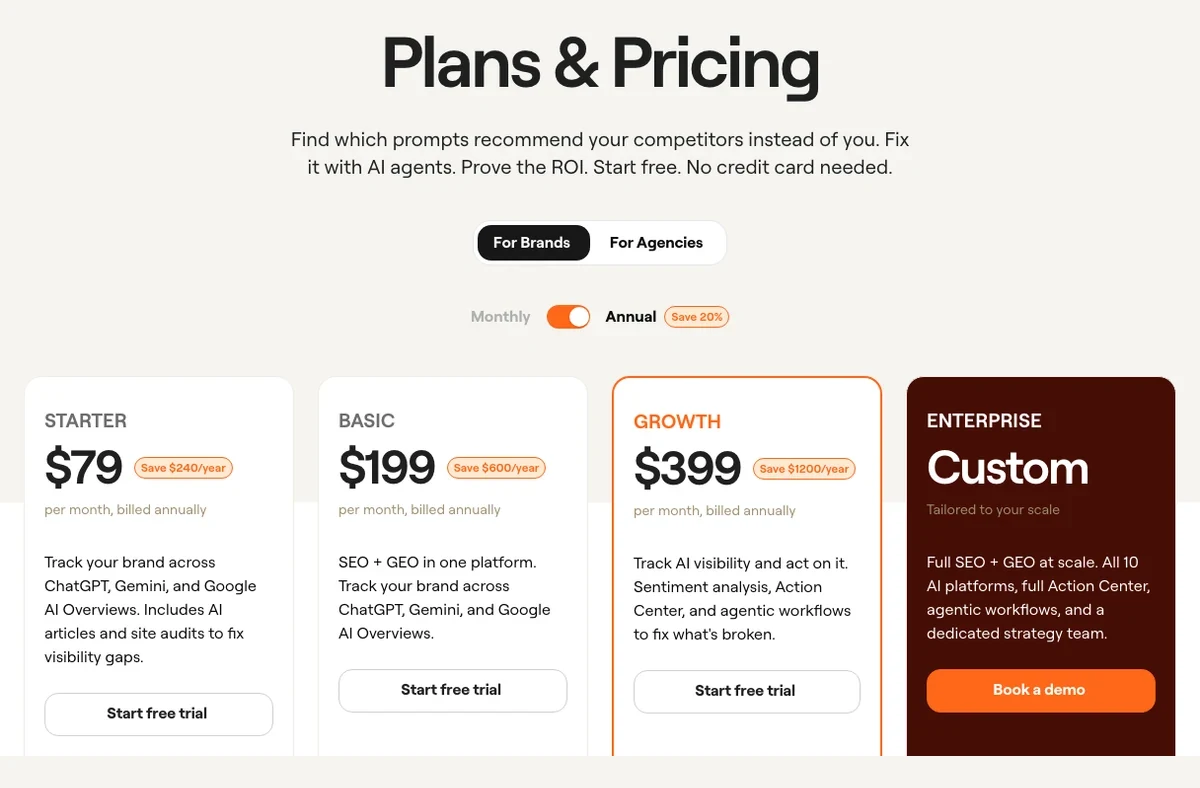
The public plan makes the monitoring scope and article allowance visible before checkout.
Skip it if you only need occasional drafting or cannot justify an annual monitoring subscription.
Writesonic ranks first because it has the clearest current self-serve purchase for the search-and-content job. The score is held back by the year-long commitment, a $79 equivalent entry point, and published limits that require careful capacity matching.
- Starter combines AI visibility tracking, site audits, and 15 AI articles per month
- The public ladder shows concrete prompt, answer, article, audit, user, and project limits
- Basic and Growth expand monitoring depth without requiring a sales call
- A free trial is available without a credit card
- The displayed $79, $199, and $399 equivalents require a year-long commitment
- Starter tracks only 50 prompts and 50 answers per day
- Sentiment analysis and broader action features sit above the entry option
- The platform is excessive for a buyer who only wants a blank-page writing assistant
Writesonic wins this guide only for the job its current product is designed to do. A team that needs to monitor visibility in AI answers, audit a site, and produce search content can evaluate one connected system. That reduces tool sprawl.
If the site platform itself is still undecided, settle that layer before buying monitoring software. Our AI website builder comparison separates seven hosted options by CMS fit, current price, and cost risk.
The countercase is straightforward. If the monitoring layer is not part of the workload, $948 per year for Starter is difficult to defend. Start with a general assistant or our free AI writing tools comparison, then pay for Writesonic when the search workflow becomes a recurring operational need.
Starter is also a capacity decision. Fifty tracked prompts and 50 captured answers per day may be enough for a focused brand set, but the package does not leave much room for a broad product catalog or several markets. The 15-article allowance should be compared with the team's real publishing schedule, not with an aspirational content calendar.
Basic raises the monitoring allowance to 100 prompts and 300 answers per day, increases production to 25 AI articles, allows two users, and expands site-audit capacity. Growth moves to 200 prompts, 600 answers, 50 articles, sentiment analysis, and larger audits. Those are meaningful increases, but the yearly commitments become $2,388 and $4,788. A team should know which limit is blocking work before moving up.
The product page supports those capacity claims. It does not prove that the generated articles are publish-ready, that visibility recommendations improve rankings, or that the monitoring catches every relevant answer. A sensible pilot uses one brand, a fixed prompt set, an existing site audit, and a known publishing queue. If that small test does not change a weekly decision, the subscription has not earned expansion.
2. Jasper: best for brand-governed marketing
Jasper Pro costs $69 per month per seat on monthly billing or $59 per month per seat when billed annually. It includes one seat, two Brand Voices, five Knowledge assets, and three Audiences. Business pricing is custom and adds deeper governance, API access, Jasper Grid, advanced agents, and unlimited IQ customization.
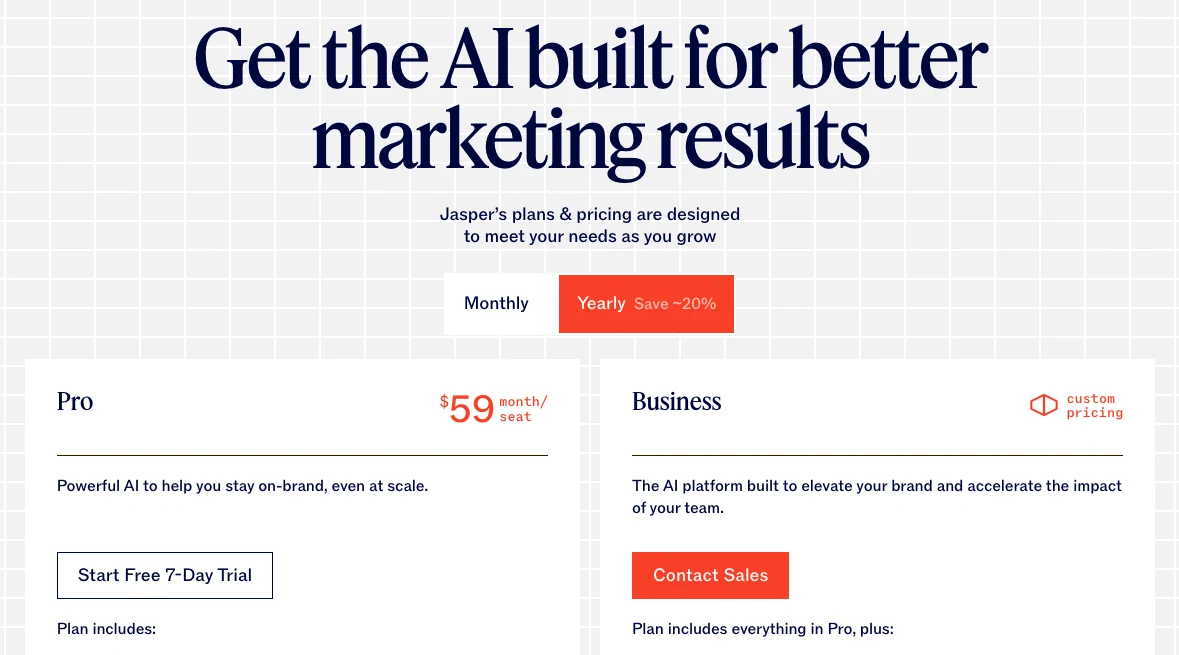
Jasper's purchase case is organizational consistency, not access to a single underlying model.
Skip Pro if one person mainly needs chat, drafting, or occasional campaign copy.
Jasper ranks second because its brand-governance case is coherent and its architecture is described as LLM-agnostic. It loses the default spot because Pro is a single-user premium offer and the strongest controls move behind a Business quote.
- Pro exposes Brand Voices, Knowledge assets, and Audiences as concrete controls
- Jasper describes its engine as LLM-agnostic and uses multiple model providers
- Business adds API access, governance, advanced agents, and Jasper Grid
- Both Pro commitment options are published
- Pro requires $708 per user each year at the lower published amount
- The public Pro offer includes only one user
- Advanced governance and API access require a Business quote
- Two Brand Voices and five Knowledge assets can become tight for multi-brand work
Jasper's value begins where a general chat subscription stops: approved brand context, reusable knowledge, audience definitions, and organizational controls. That is a real distinction. It also means a solo writer should not buy Jasper merely because the templates look convenient.
I would shortlist Jasper when inconsistent marketing output is already causing review work across a team. I would not pay $59 for each user under a yearly commitment to solve a vague desire for "better AI writing." The official page does not prove output quality, and this review did not test it.
Pro is the easiest way to test the system, but its boundaries matter. Two Brand Voices may cover a main brand and one product line. Five Knowledge assets can hold a compact source set. Three Audiences can support a narrow campaign mix. A company with several brands, regions, or product families can reach those limits before the editorial team has finished proving the workflow.
Business is where Jasper's organizational case becomes stronger. The official page moves advanced agents, custom agents, Jasper Grid, API access, governance, support, and unlimited IQ customization into that package. The missing public quote is therefore not a small detail. It prevents a buyer from comparing total team spend without entering a sales process.
A disciplined Jasper pilot should use one approved brand brief, a limited knowledge set, and two campaign types. Track how often editors correct tone, facts, and audience fit before and after the setup. That measurement does not require pretending the software writes better. It asks the more useful question: does controlled context reduce review work enough to justify $708 per user each year?
3. Copy.ai: best cheap chat plan, awkward upgrade path
Copy.ai Chat costs $29 per month on monthly billing or $288 per year. It includes five seats, unlimited words and projects, and access to models from OpenAI, Anthropic, and Gemini. The next published tier is Growth at $1,000 per month billed annually, with 75 seats and 20,000 workflow credits.
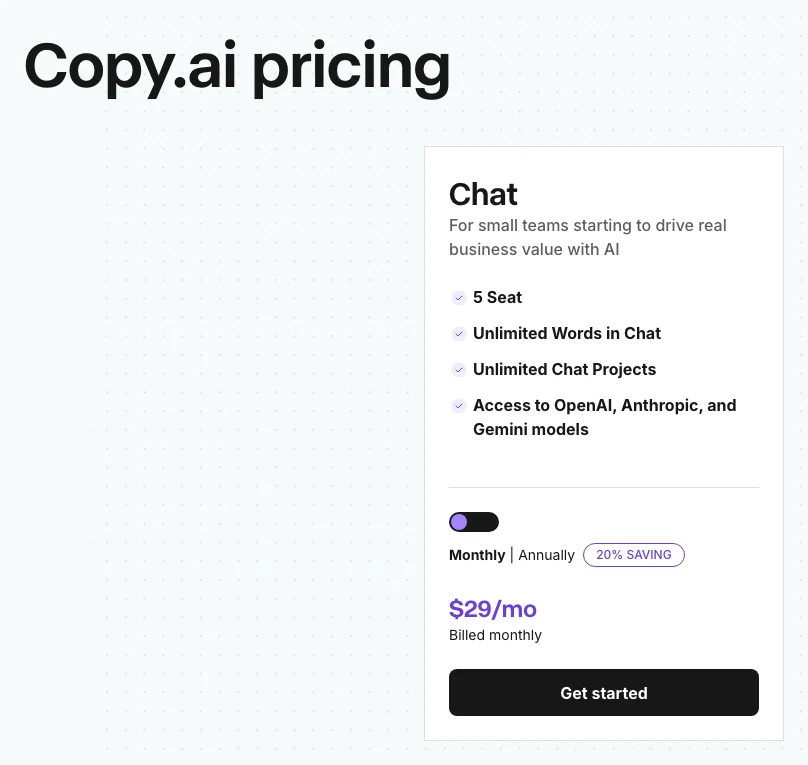
Five seats and multiple model providers make Chat inexpensive for a small team.
Skip it if you expect to grow gradually from chat into affordable self-serve workflow automation.
Copy.ai ranks third because Chat is unusually affordable for five users, but the public ladder jumps from $29 to a $12,000 yearly Growth commitment. That gap makes the broader platform difficult to adopt incrementally.
- Chat includes five users for $29
- Unlimited words and projects are stated on the public card
- Chat includes access to OpenAI, Anthropic, and Gemini models
- Large workflow packages publish user and workflow allowances
- The next public option starts at $1,000 under a yearly contract
- Workflow allowances are not part of the low-commitment Chat offer
- The public ladder has no mid-market bridge between Chat and Growth
- Enterprise integrations, API access, and security controls sit in the custom package
Copy.ai Chat is the value outlier in a good way. Five people can share a $29 subscription without committing to a large contract. For lightweight team chat and drafting, that is a credible case.
The annoying part is the upgrade path. Growth is not a larger Chat offer. It is a different operating model built around workflow allowances and many more users. A small team planning gradual automation should treat the $29 option and the $1,000 platform as separate products, not consecutive steps.
The user count can also distort the comparison. Five included accounts look generous beside Jasper's one, but unused access has no value. Chat earns its place when several people need shared access to OpenAI, Anthropic, and Gemini models and the team wants unlimited chat projects under one subscription. It gains nothing from accounts that never become active.
Growth includes 75 users and 20,000 workflow credits. Expansion increases that to 150 users and 45,000 usage units at $2,000 under a yearly contract. Scale lists 200 users and 75,000 usage units at $3,000 under the same commitment. Those packages make sense for a larger go-to-market operation, not as a casual upgrade for a five-person content team.
Before entering that sales conversation, document one workflow in plain language: trigger, data source, model step, approval, destination, expected volume, and failure owner. Then ask Copy.ai to map every step to allowances, integrations, security controls, and support. If the team cannot estimate the yearly workload, it cannot evaluate whether 20,000 workflow credits are generous or restrictive.
The commitment changes the recommendation
At the lowest published yearly commitment, one Jasper Pro user requires $708. Writesonic Starter requires $948. Copy.ai Chat requires $288 and includes five users. Those totals are not equivalent because the products do different work, but they expose the risk of buying the wrong category.
A solo writer can spend less with a general AI assistant and keep the workflow simple. A brand team may rationally pay more for Jasper if reusable context and approval controls reduce review cycles. A search team can justify Writesonic only when visibility monitoring, site auditing, and content production are all active jobs. Copy.ai Chat is cheap, but its workflow platform is an enterprise-scale decision.
Do not compare the displayed labels without the commitment behind them. Jasper's $59 figure requires a year and applies to each user. Writesonic's three public dollar amounts use the same yearly structure. Copy.ai Chat offers flexible access, while the $1,000, $2,000, and $3,000 workflow packages require yearly contracts. Cash timing and contract flexibility are part of the product decision.
The lowest-risk sequence is different for each vendor. Copy.ai Chat can be tried without a long contract. Jasper offers a seven-day Pro trial, so the brand-context setup should be prepared before the trial begins. Writesonic advertises a no-card trial, but a team should decide which monitoring and content limits it needs to validate before evaluating a yearly package.
A pilot that can produce a real answer
Use the same business brief across the shortlist, but do not force identical tasks onto products built for different jobs. The baseline should include one approved brand document, one target audience, one existing article or campaign, one search-visibility question, and one recurring workflow the team already performs manually.
For Jasper, test whether Brand Voice, Knowledge, and Audience controls reduce factual and tone corrections. For Writesonic, test whether tracked prompts, site-audit findings, and the article workflow change a publishing or optimization decision. For Copy.ai Chat, test whether five-seat model access replaces separate subscriptions; for Growth, require a credit estimate for the chosen automation.
Write the stop condition before the pilot. Examples: more than two hours of setup without a reusable workflow, no measurable reduction in review steps, monitoring data that does not change priorities, or an automation whose credit use cannot be forecast. A stop condition protects the team from converting setup effort into a reason to keep paying.
Finally, keep the general assistant baseline in the test. If ChatGPT or Claude handles the actual job with a shared brief and a simple review checklist, the specialized platform has not yet justified its extra operating layer. That is not a failure of the product. It is a sign that the organization is not ready to buy the workflow.
How to choose between Jasper, Copy.ai, and Writesonic
Choose Writesonic when the recurring job combines AI-search monitoring, SEO auditing, and article production. Count the prompts, tracked answers, articles, site audits, users, and projects before choosing a package.
Choose Jasper when several people need controlled brand context and the organization can evaluate a per-user subscription. Ask sales which Business controls are required before treating Pro as a team solution.
Choose Copy.ai Chat when up to five people need inexpensive multi-model chat. Treat Growth as a separate procurement decision with a $12,000 yearly starting commitment.
Choose none of them when the real need is occasional drafting, research, or editing. Our ChatGPT vs Claude comparison covers the broader assistant decision, while the AI SEO tools guide is a better starting point when you need a wider search stack.
Also considered: ChatGPT and Claude
ChatGPT and Claude are the obvious alternatives, but they are not ranked here because this guide is about specialized marketing systems. They are better baselines for solo work and general assistance. They do not replace a documented brand-governance layer or an AI-visibility monitoring platform by default.
That distinction matters. A specialized tool should earn its premium by changing the workflow, not by hiding a familiar model behind templates.
Final verdict: buy the workflow, not the AI-writer label
Writesonic is the best default here for a team that genuinely needs AI visibility and content operations. Jasper is the better fit for controlled brand work. Copy.ai Chat is the budget choice for five-seat chat, but Copy.ai's automation platform begins at a different scale.
The main risk is paying for an operating layer that nobody owns. If no one is responsible for brand governance, automated workflows, or AI-visibility monitoring each week, avoid all three specialized platforms and keep a general assistant as the baseline.
The strongest counterargument to Writesonic is also the simplest: many readers do not need its monitoring layer. If that is you, do not let a feature-rich package manufacture a problem. Start with the cheaper general assistant and return when the specialized workload is measurable.
Frequently Asked Questions
Writesonic leads this specialized comparison for search and content teams, but the score reflects its yearly commitment and capacity limits. Jasper is the stronger brand-governance choice; Copy.ai Chat is the low-commitment five-user option.
See pricingReady to check Writesonic?
Use the verified route if the trade-offs still fit. If not, jump back to the summary and compare the alternatives.
AI tools editor focused on public docs, changelogs, API limits, free-tier constraints, and developer community feedback. Turns fast-moving AI claims into buyer-focused recommendations without implying undocumented hands-on testing.
Anthony starts with the workload behind the demo, then ranks AI tools by documented model access, limits, implementation clarity, failure behavior, and the cost of an acceptable result.
Related Articles

Bardeen vs Zapier Agents vs Lindy: Best AI Coworker
AI coworkers compared by starting context, agent authority, usage economics, approval boundaries, and offboarding clarity
Compare Bardeen, Zapier Agents, and Lindy by workflow fit, approvals, credits, integrations, browser permissions, and cancellation terms.

GPT-5.6 vs Claude Sonnet 5 API: Which Tier Fits?
Production API model routing guide
GPT-5.6 Sol, Terra, and Luna compared with Claude Sonnet 5 on API price, long context, tokenization, migration risk, tools, and workload fit.