

The expensive mistake in a frontier-model migration is not choosing the “wrong” benchmark winner. It is routing every request to the most capable tier, then discovering that tokenization, long context, or a rejected parameter changed the economics of the whole system.
GPT-5.6 Terra is my production default. At the public API rate checked on August 12, it costs $2 per million input tokens and $12 per million output tokens while keeping the 1.05M context window, 128K maximum output, and the same visible tool set as Sol. Claude Sonnet 5 is the better first migration for Claude-heavy coding and agent systems, but its new tokenizer and three request-behavior changes need a real canary. GPT-5.6 Luna is the batch-volume play. Sol belongs behind an escalation rule, not under every request.
This page owns the production API routing decision. If you are choosing a consumer chatbot, read ChatGPT vs Claude. If you are buying an editor or terminal agent, use the coding-agent cost guide. The premium AI plan comparison covers $100 and $200 subscriptions rather than metered API traffic.
This is an evidence-led buyer guide. I checked the live OpenAI model catalog, OpenAI model documentation, Anthropic's Sonnet 5 launch and migration documentation, current search competitors, public evidence frames, and live D1-backed routes. I did not run proprietary prompts, latency tests, quality benchmarks, batch jobs, cache-hit experiments, safety evaluations, or a production migration. Treat the ranking as a workload-routing starting point, then validate it on your own traces.
-
#1 GPT-5.6 TerraBest production default when capability, price, long context, and broad tool support all matter
-
#2 Claude Sonnet 5Best Claude-first migration for coding and agentic work after token and request-shape canaries
-
#3 GPT-5.6 LunaBest high-volume tier for extraction, classification, routing, and retry-tolerant background work
-
#4 GPT-5.6 SolBest escalation tier for the hardest professional reasoning and coding requests
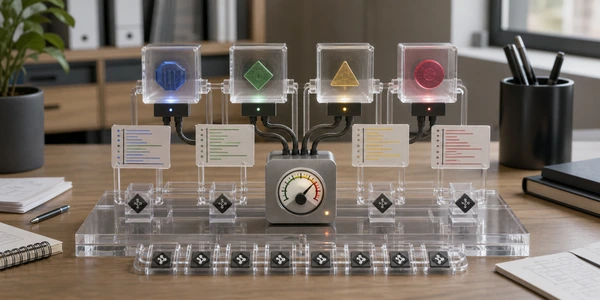
Start with GPT-5.6 Terra when you need one sensible production baseline. Compare Claude Sonnet 5 when the application already depends on Claude's agent behavior. Route repetitive background work to Luna , and let measured failure or uncertainty, not prestige, promote a request to Sol .
How to choose the route before the model
OpenAI's live catalog gives the three GPT-5.6 tiers a clean 25-to-1 input-price spread. Sol is $5 input and $30 output per million tokens. Terra is $2 and $12. Luna is $0.20 and $1.20. All three cards show a 1.05M context window, 128K maximum output, and functions, web search, file search, and computer use.
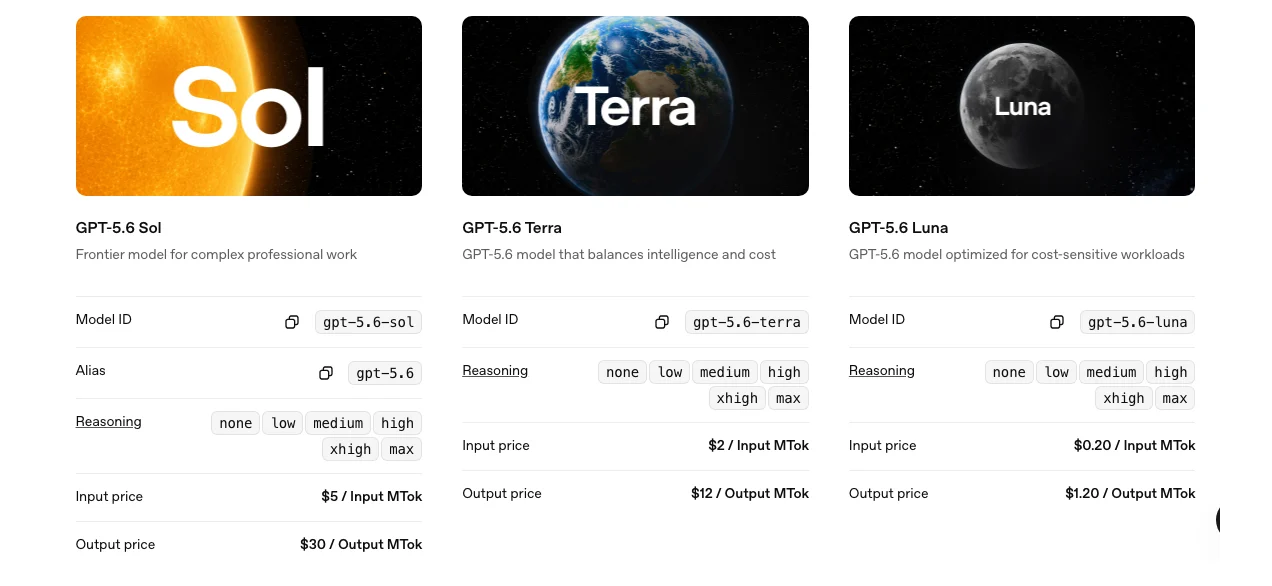
At one million input and 100,000 output tokens, that public-rate job is about $8 on Sol, $3.20 on Terra, and $0.32 on Luna before caching, batch discounts, tool charges, or long-context modifiers. Claude Sonnet 5 is about $3 at its $2 input and $10 output rates. One sample bill cannot predict production spend, but it shows why “use the best model” is not an architecture.
The useful pattern is a ladder. Put deterministic extraction, moderation-adjacent preprocessing, classification, and simple transformations on Luna only after they clear accuracy gates. Put the normal agent and coding path on Terra. Promote low-confidence, high-value, or repeatedly failing work to Sol. Keep Sonnet 5 as a primary route when its behavior wins on your actual task, or as an independent second model when correlated failure matters.
| Feature | GPT-5.6 Terra | Claude Sonnet 5 | GPT-5.6 Luna | GPT-5.6 Sol |
|---|---|---|---|---|
| Best production job | Default coding, agents, analysis, and tool-using requests | Claude-first coding and agent systems that benefit from adaptive thinking | High-volume classification, extraction, routing, and background transforms | Hard professional reasoning, coding, recovery, and high-value escalation |
| Official API price checked | $2 input; $12 output per million tokens | $2 input; $10 output per million tokens | $0.20 input; $1.20 output per million tokens | $5 input; $30 output per million tokens |
| Context and output | 1.05M context; 128K max output | 1M context by default; 128K max output | 1.05M context; 128K max output | 1.05M context; 128K max output |
| Migration risk | Validate Responses API behavior, tools, safety, and long-context billing | New tokenizer; adaptive thinking default; some old request fields return 400 | Lower-cost tier still needs task-level accuracy and tool-use gates | High unit price makes unbounded default routing expensive |
| Cost trigger | Long prompts and verbose outputs; promote only measured hard cases to Sol | Same text uses about 30% more tokens than Sonnet 4.6 | Retries or escalation can erase savings if the first-pass floor is too low | Long context plus long output; repeated agent loops multiply the premium |
| Skip if | A cheaper tier already clears your task-specific quality floor | You cannot recount prompts and canary request-shape changes before migration | A wrong answer is costly and cannot be caught automatically | The request does not justify a 2.5x premium over Terra |
| Action | Open OpenAI Platform | Open Claude Console | Open OpenAI Platform | Open OpenAI Platform |
Sonnet 5 is not a zero-work drop-in
Anthropic calls Sonnet 5 a drop-in upgrade from Sonnet 4.6, then documents three behavior changes that can break an unchanged request. Adaptive thinking is on by default. Manual extended thinking with a fixed token budget returns a 400. Non-default temperature, top_p, or top_k values also return a 400.
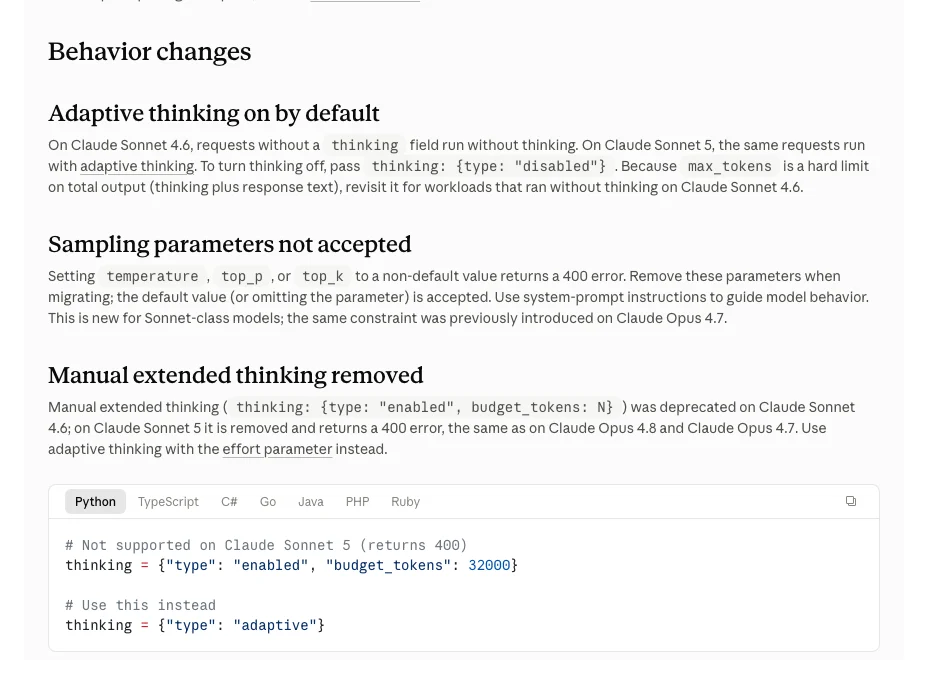
The canary should therefore watch more than answer quality. Count 400s by request template. Track thinking tokens and truncation because max_tokens covers thinking plus response text. Separate latency and cost by tool path. Keep the Sonnet 4.6 route available until the request builder, output parser, safety handling, and retry policy all pass.
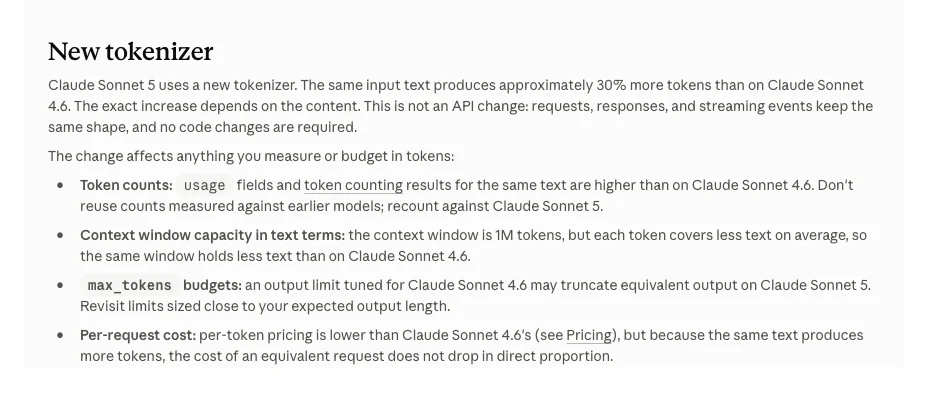
The tokenizer is the quieter surprise. Anthropic says the same input produces approximately 30% more tokens than on Sonnet 4.6. That changes prompt budgets, context capacity in practical text terms, output limits tuned near the edge, and cost comparisons. A lower posted rate does not translate directly into the same percentage reduction on an equivalent document.
Cache and long context can reverse the headline price
Posted input rates assume ordinary uncached tokens. Production systems rarely stay that simple. OpenAI's current Terra model page lists cached input at $0.20 per million tokens, one tenth of its $2 standard input rate. It also says cache writes cost 1.25 times the uncached rate. Anthropic lists the same $0.20 cache-hit rate for Sonnet 5, a five-minute cache write at $2.50, and a one-hour write at $4 per million tokens.
That creates a reuse threshold rather than a universal winner. A stable system prompt, tool schema, policy block, or document prefix can become dramatically cheaper after a hit. A prefix that changes on every request never earns the discount. A one-hour Anthropic write costs twice the base input rate, so it needs repeated reads during that hour to justify itself. Anthropic's pricing documentation says the five-minute write pays off after one cache read, while the one-hour write pays off after two.
Cache structure also changes engineering behavior. Put reusable tools, system instructions, examples, and reference material before volatile conversation content. Measure write tokens, read tokens, miss rate, and time-to-next-request separately. A team that reports only total input tokens will not know whether a prompt refactor improved model quality or merely destroyed its cache prefix.
Long context has a provider-specific trap. Anthropic says Sonnet 5 includes the full 1M context window at standard pricing. OpenAI's current Terra page says prompts above 272K input tokens are charged at twice the input rate and 1.5 times the output rate for the full request. On Terra, a request that crosses that boundary does not pay the multiplier only on the excess. The whole request moves to the higher rate.
That threshold should be visible in routing telemetry. Count the prompt before dispatch, warn well below the boundary, and decide whether retrieval, summarization, chunking, or a Sonnet route is cheaper for the task. Do not split blindly: some work needs cross-document relationships that retrieval can miss. The point is to make the trade explicit before a 273K-token request quietly changes both sides of the bill.
Batch is the third lever. Anthropic documents a 50% Batch API discount for asynchronous volume and allows batch discounts to combine with prompt caching. OpenAI exposes a Batch endpoint for the GPT-5.6 family. The operational question is whether the job can wait. Nightly classification, offline evaluation, enrichment, and bulk extraction often can; interactive coding, support, and tool loops usually cannot. Separate those queues instead of paying synchronous rates for work nobody is waiting to see.
A useful forecast therefore has at least six rows: uncached input, cache writes, cache reads, output, tool charges, and retries. Add a seventh for long-context multipliers where they apply. This turns a model comparison into an observable system instead of a spreadsheet built from two headline numbers.
How I ranked the four production routes
The shared score weights Production Value at 30%, Migration Safety at 20%, Context Economics at 20%, Tooling Fit at 15%, and Price Clarity at 15%. This is intentionally not a raw intelligence leaderboard. A model can be excellent and still rank lower when its best role is a narrow escalation path.
Terra scores 8.8 because it offers the cleanest default balance. Sonnet 5 scores 8.6 because its price and agent fit are strong, while the tokenizer and request changes add migration work. Luna scores 8.1 because huge unit savings are valuable only where automated checks can catch weak first passes. Sol scores 7.8 because the highest-capability lane is too expensive to be the unexamined default.
1. GPT-5.6 Terra: the production default
Terra is where I would begin a new general production evaluation. It carries the same listed context, maximum output, reasoning levels, and tool families as Sol at 40% of Sol's token price. That does not prove equal output quality. It means Terra has to lose on a measured task before the system pays the Sol premium.
The strongest use case is a mixed queue: code changes, document analysis, function calling, search, file work, and medium-complexity agents. Use request-level telemetry to identify the slice that fails. If 8% of jobs need Sol, route that 8%; do not turn the exception into the base rate.
Terra keeps the GPT-5.6 family's visible context, output, reasoning, and tool surface at 40% of Sol's token price.
Skip Terra as the default only when a cheaper tier clears your quality floor or a measured hard-task slice consistently needs Sol or Sonnet.
Terra wins because production defaults need strong capability and broad tools without charging the specialist-tier premium on every request.
- Balanced $2/$12 public token rate
- 1.05M context and 128K maximum output
- Same listed tool families as Sol and Luna
- Clear promotion path to Sol for measured hard cases
- Not the lowest-cost tier in the family
- Long-context and tool-heavy requests still need cost controls
- Public specifications do not replace workload-specific quality tests
- A single-provider default can create correlated operational risk
2. Claude Sonnet 5: the Claude-first agent route
The Claude Sonnet 5 API is the more interesting alternative than its $2/$10 sticker suggests. Anthropic positions its largest gains around coding and agentic work, gives it a 1M default context and 128K maximum output, and enables adaptive thinking by default. For an existing Claude stack, the model ID change is easy. Proving that the surrounding request builder still behaves is the real job.
I would choose it over Terra when a representative canary wins on completion quality, tool recovery, or total task cost after counting the new tokens. I would not choose it because $10 output looks two dollars cheaper. Equivalent-text tokenization, thinking, retries, and latency can overwhelm a small posted-rate difference.
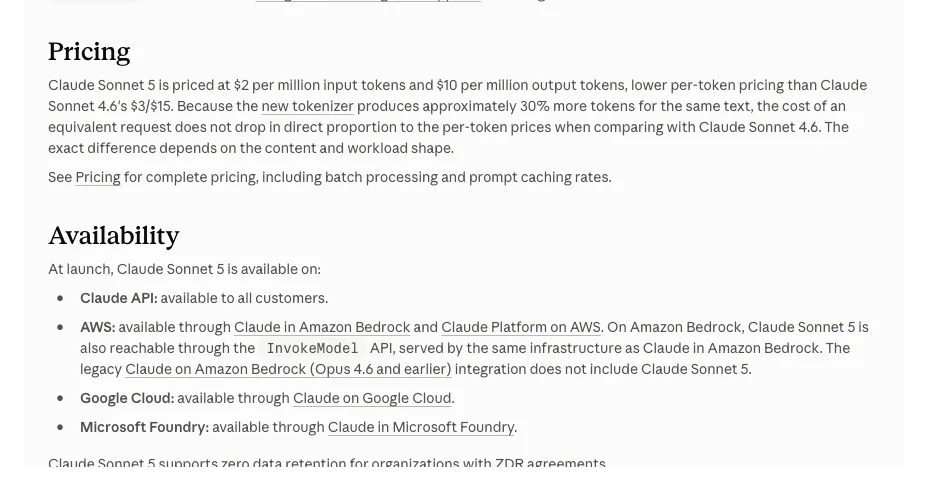
Sonnet 5 combines a competitive public rate with a 1M default context, 128K maximum output, and a clear coding and agent focus.
Skip a direct cutover if your requests still set manual thinking budgets or non-default sampling parameters, or if you cannot recount prompts first.
Sonnet 5 nearly wins, but the new tokenizer and request-shape errors make it a canary-first migration rather than the lowest-friction default.
- Competitive $2/$10 public token rate
- 1M context is the default and maximum
- 128K maximum output with adaptive thinking
- Strong fit for Claude-centered coding and agent systems
- Same text uses approximately 30% more tokens than Sonnet 4.6
- Manual extended thinking returns a 400 error
- Non-default temperature, top_p, and top_k return 400 errors
- Priority Tier was not available at launch
3. GPT-5.6 Luna: the volume route
Luna changes the unit economics enough to deserve its own queue. Its $0.20 input and $1.20 output prices are one tenth of Terra's and one twenty-fifth of Sol's. That makes it attractive for jobs with a clear contract: extract these fields, classify this item, normalize this record, choose a route, or draft a low-risk first pass.
Retry math is the constraint. A cheaper first pass is not cheap if it creates silent errors, repeated tool calls, or human review. Define an automatic acceptance test and escalation threshold before moving volume. Luna is a production tier, not permission to lower the quality bar invisibly.
Luna costs one tenth of Terra per token while retaining the family’s listed context, output, reasoning, and tool surface.
Skip Luna where mistakes are expensive, subjective quality is the product, or no automatic validator can catch a weak answer.
Luna's unit cost is exceptional, but its safest production role is bounded work with validation and escalation rather than an unrestricted default.
- Lowest public token rate in the compared set
- 1.05M context and 128K maximum output
- Useful for classification, extraction, routing, and background transforms
- Can make large-scale canaries and shadow traffic affordable
- Lower capability tier needs task-specific accuracy gates
- Retries and review can erase nominal savings
- Large context does not guarantee reliable use of every token
- High-value open-ended work may need immediate escalation
4. GPT-5.6 Sol: the escalation tier
Sol is the model OpenAI tells uncertain buyers to start with for complex reasoning and coding. For evaluation, that is reasonable: it establishes a capability ceiling. For production routing, the $5/$30 price makes the next question unavoidable—what percentage of requests actually need that ceiling?
Give Sol the tasks where a failed first pass costs more than the premium: difficult repository changes, recovery after another route stalls, high-value synthesis, or cases where your own evaluator predicts low confidence. If the route cannot explain why a request was promoted, it will become the expensive default by habit.
Sol is the clear capability-ceiling route in OpenAI's current family and keeps the full listed context, output, reasoning, and tool surface.
Skip Sol as the blanket default when Terra or Luna clears the task-specific quality floor or when requests carry large context and verbose output.
Sol is valuable but ranks fourth for a cost-aware routing decision because its best production role is selective escalation, not indiscriminate default traffic.
- Flagship route for complex professional work
- 1.05M context and 128K maximum output
- Full listed reasoning range and tool support
- Useful capability ceiling for evaluations and recovery
- Highest input and output token prices in this comparison
- Costs 2.5x Terra at the public token rates
- Long agent loops multiply the premium quickly
- Defaulting all traffic to Sol hides routing opportunities
A rollout plan that survives the first invoice
Build a frozen evaluation set from real, permitted traffic shapes: short tool calls, long documents, code changes, failures, and edge cases. Record input tokens, output tokens, tool calls, retries, wall time, acceptance, and human corrections. Recount the Sonnet set with its own tokenizer. Do not normalize all models with a token count borrowed from one provider.
Keep the evaluator independent from the route where possible. Exact-match fields, schema validity, test suites, citation presence, and policy checks can be automated. Writing quality and difficult reasoning still need blinded human review. Save the rejected outputs too: they reveal whether a cheaper route fails predictably enough to escalate or unpredictably enough to avoid.
Then shadow, canary, and route. Shadowing measures without user impact. A small canary exposes request-builder and parser failures. Routing starts only after the model clears a task-specific floor. Put a budget cap around agent loops, keep a rollback route, and report cost per accepted task—not cost per token alone.
That last metric is the one worth defending. Luna can be the cheapest token and the most expensive accepted result if review is heavy. Sol can be the highest-priced token and the cheapest recovery if it prevents a failed deployment. Terra wins this guide because it gives the broad middle of the queue a credible default. Sonnet 5 remains close because a Claude-native workload may reverse the order on its own traces.
Verdict: default to Terra, then earn every escalation
Choose GPT-5.6 Terra for the general production lane. It has the best balance of current public price, context, output, tools, and migration simplicity. Choose Claude Sonnet 5 when Claude's agent behavior wins a canary, but remove rejected parameters and recount prompts before cutting over. Choose Luna for bounded volume with automatic checks. Choose Sol when the request earns the premium through difficulty, value, or failed lower-tier attempts.
The practical buying rule is simple: route by cost per accepted task. Start a production evaluation on OpenAI's API platform , or run a parallel canary through the Claude Console . Keep the first rollout reversible.
Frequently Asked Questions
Ready to check GPT-5.6 Terra?
Use the verified route if the trade-offs still fit. If not, jump back to the summary and compare the alternatives.
AI tools editor focused on public docs, changelogs, API limits, free-tier constraints, and developer community feedback. Turns fast-moving AI claims into buyer-focused recommendations without implying undocumented hands-on testing.
Anthony starts with the workload behind the demo, then ranks AI tools by documented model access, limits, implementation clarity, failure behavior, and the cost of an acceptable result.
Related Articles

Bardeen vs Zapier Agents vs Lindy: Best AI Coworker
AI coworkers compared by starting context, agent authority, usage economics, approval boundaries, and offboarding clarity
Compare Bardeen, Zapier Agents, and Lindy by workflow fit, approvals, credits, integrations, browser permissions, and cancellation terms.
Claude Code vs Cursor vs GitHub Copilot: The Coding Agent Cost Trap
4 AI coding-agent paths compared by official pricing, AI credits, quota risk, agent depth, IDE fit, usage visibility, and team controls
Claude Code, Cursor, GitHub Copilot, and Devin Desktop compared by official pricing, AI credits, quotas, IDE fit, agent depth, and billing-risk.