

“Private AI” is not one feature. One service can hide your identity from a model provider, another can encrypt saved chat history, and a third can isolate inference in secure hardware. Those are different protections, and the difference matters more than the word private on a landing page.
For sensitive work that needs searchable history, Proton Lumo is my first comparison. Its clearest advantage is zero-access encryption for saved conversations, backed by a no-training and no-chat-log policy. Duck.ai is the easiest free choice when no account and access to several third-party models matter more than keeping a cloud history. Venice AI is the specialist for buyers who want open-model breadth, image and video tools, API access, and explicit privacy modes.
This is an evidence-led buying guide. I reviewed current official pricing, privacy documentation, model and limit pages, visible plan cards, recent product changes, one current community purchase question, and the evidence frames below. I did not create paid accounts, send private files, benchmark response quality, test deletion or support, or inspect network traffic.
If your main decision is raw model capability rather than data handling, start with ChatGPT vs Claude or our premium AI plan guide. For browser-level privacy, the privacy browser comparison owns that separate purchase job. Teams already using Proton should also understand the broader account boundary in Proton Mail vs Tuta.
-
#1 Proton LumoBest for encrypted saved history and a conventional private assistant workflow
-
#2 Duck.aiBest no-account entry point with transparent provider exceptions and paid frontier-model access
-
#3 Venice AIBest for open models, creative tools, API access, and selectable privacy architecture
My default recommendation is conditional, not absolute. Compare Lumo first when saved history itself is sensitive. Use Duck.ai when the priority is no-account access and model choice. Choose Venice when the workflow needs private or anonymous open-model inference, images, video, or an API.
The private AI decision has four separate layers
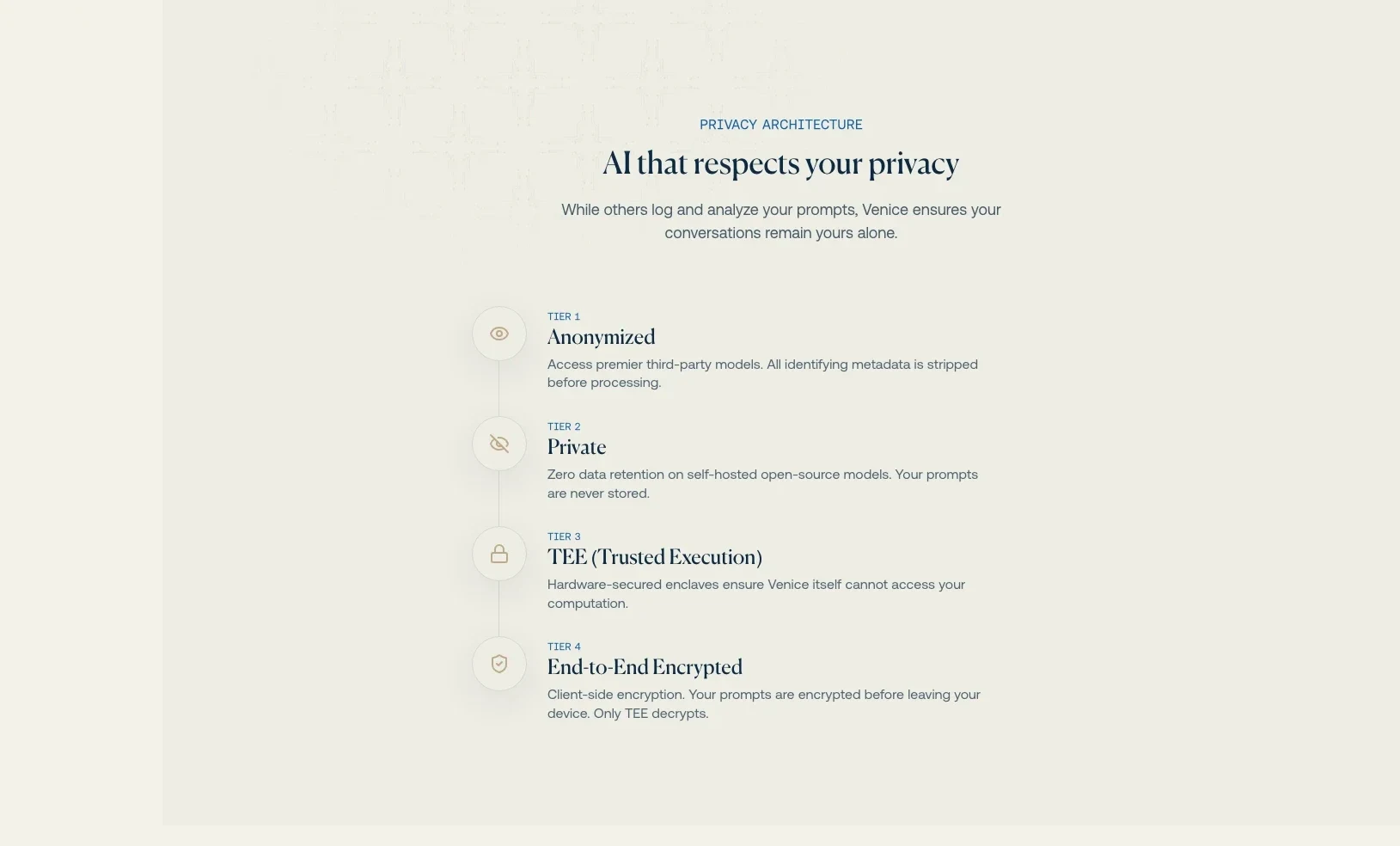
The cleanest way to compare these services is to follow one prompt. First, does the service know who sent it? Second, who performs inference and can that operator see the prompt? Third, what can a model provider retain while producing a response? Fourth, where does the conversation live afterward?
Duck.ai is strongest at the identity layer: it removes identifying metadata before forwarding prompts to model providers and does not require an account for free chat. Lumo is strongest at the saved-history layer: signed-in conversations are stored with zero-access encryption, so Proton says it cannot read them. Venice exposes the most varied inference layer, from anonymized third-party processing through self-hosted zero-retention models to TEE and end-to-end encrypted modes on supported models.
This is also why I would not put regulated, privileged, or identifying material into any hosted AI chat merely because the homepage says private. Product architecture can reduce exposure. It does not replace your employer's data policy, a professional confidentiality obligation, or a local model when the cloud itself is outside the threat model.
How I ranked these private AI chat services
The score gives Privacy Architecture 30%, Policy Clarity 20%, Plan Value 20%, Capability Breadth 15%, and History Control 15%. The same weights apply to all three tools. I gave more credit for a narrow boundary I could verify than for a broad privacy promise whose protection changes by model or mode.
Three workflows expose the real differences
Start with a consultant who needs to return to research notes for several weeks. Local-only history becomes a nuisance because the work has to survive a cleared browser, a replacement device, and travel between computers. Lumo is the cleanest fit here. Its saved-history design keeps the normal convenience of search and continuity while Proton says the stored conversations remain inaccessible to the service. That does not approve a client's confidential files, but it addresses the practical failure this person is paying to avoid.
Now take someone who asks occasional questions from a shared or temporary machine and does not want another account. Duck.ai has the better starting point. The conversation can remain local, identifying metadata is removed before provider processing, and the free service offers more than one model path. The trade-off appears when the prompt matters enough to inspect the provider row. A request sent to a Tinfoil-hosted model does not have the same documented exception set as one sent to OpenAI or Anthropic. Model choice is part of the data decision, not a cosmetic dropdown.
The third case is a developer or creator who needs text, images, video, and API calls inside one account. Lumo's focused assistant and Duck.ai's private gateway become restrictive. Venice is the stronger purchase because its breadth is the point, but the user has more homework. A self-hosted private model, a TEE-backed option, and an anonymized third-party model should not inherit one shared risk label. The active mode must be checked again when the model or media job changes.
Those scenarios also explain why there is no honest universal winner. Lumo optimizes continuity without readable stored history. Duck.ai minimizes identity friction and documents provider boundaries. Venice gives technical users more ways to trade capability against the processing path. The ranking puts the most common private-assistant job first; it does not claim that the first-place tool replaces the other two.
Files and chat history deserve separate decisions
A pasted paragraph and an uploaded file do not always follow the same safeguards. DuckDuckGo says files and images pass through abuse scanning, even though ordinary chat requests are anonymized before provider processing. Lumo's public model and plan pages describe file support and encrypted history, but I did not inspect an upload request or verify deletion inside an account. Venice changes its processing protection by selected model and mode. For any document that identifies a person, project, employer, or client, read the file rule as its own policy rather than extending a homepage promise to every attachment.
History is a second decision. Local history reduces cloud storage exposure, but it can disappear with browser data and may not follow you to another device. Encrypted cloud history is more convenient, yet account recovery and synchronization become part of the threat model. Anonymous use removes one identity link, but it can also make continuity and support harder. Decide whether the prompt should be recoverable before choosing the product, then keep the history setting consistent with that answer.
My practical rule is conservative: use a disposable chat for disposable questions, encrypted history for work you are permitted to retain, and an approved enterprise or local system when the data owner would object to any consumer cloud processor. A lower subscription price cannot compensate for choosing the wrong data path.
Pricing is simple; usable limits are not
All three have a free entry point. The paid decision is less symmetrical. Lumo sells more use of its own private assistant. DuckDuckGo bundles stronger Duck.ai models with a VPN, personal information removal, and identity restoration. Venice sells a broader creative and developer platform with credits layered on top of the core subscription.
| Feature | Proton Lumo | Duck.ai | Venice AI |
|---|---|---|---|
| Best fit | Sensitive work that needs encrypted, searchable saved history | No-account private chat and access to several model providers | Open-model, multimodal, uncensored, and API-heavy workflows |
| Price checked | Free; Lumo Plus €12.99 monthly or €9.99/month billed €119.88 yearly | Free; Plus $9.99/month or $99.99/year; Pro $19.99/month or $199.99/year | Free; Pro $18/month, Pro+ $68/month, Max $200/month; annual saves 10% |
| Account and history | Guest access is limited; signed-in history uses zero-access encryption | No account required; local history by default; encrypted Sync & Backup is optional | Anonymous use is available; history behavior and privacy depend on mode |
| Inference path | Proton-operated service using open models; policy says no chat logs or training | DuckDuckGo anonymizes requests before third-party or Tinfoil processing | Anonymized, private, TEE, or end-to-end encrypted depending on selected model |
| Paid-plan change | More Max use, messages, images, unlimited Projects and Custom Lumos | Advanced models; Pro adds Claude Opus, higher reasoning, and 2x Plus limits | Unlimited text, larger image allowance, credits, API, video, and higher limits |
| Main caveat | Official plan cards still describe usage as more rather than publishing exact quotas | Exact daily and weekly quotas are not published and provider exceptions vary by model | The broadest product also has the most privacy-mode and credit complexity |
| Action | Compare Lumo | Compare Duck.ai | Compare Venice |
1. Proton Lumo: best when saved history is sensitive
Lumo wins this buying job because its promise is the easiest to map to normal private work. Signed-in chats are searchable and saved, but Proton says the history is protected with zero-access encryption. The company also says it does not keep chat logs, does not use conversations to train models, and publishes its client code.
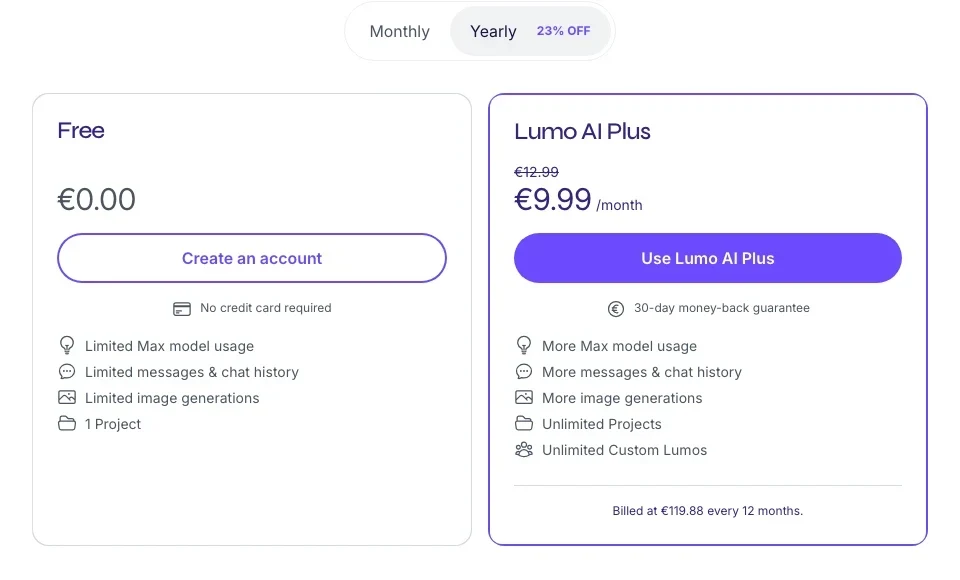
The paid plan is legible on the current EU page: €12.99 month to month or €9.99 per month billed at €119.88 yearly. Plus raises Max-model, message, history, and image allowances and removes the Project and Custom Lumo caps. The frustrating part is that the cards say “more” rather than publishing exact quotas.
The strongest countercase is capability. Privacy architecture does not make an assistant better at every prompt, and I did not run a head-to-head output test. A buyer who needs a specific frontier model may prefer Duck.ai's provider gateway or Venice's broader catalog. Lumo remains first only for the reader whose purchase begins with confidential, recoverable history.
Lumo gives the clearest answer for readers who need searchable cloud history without giving the service readable access to that stored history.
Skip it if a named frontier model, exact published quotas, API access, or broad creative generation matters more than encrypted history.
Lumo ranks first for this privacy-led purchase because zero-access saved history and a focused plan are easier to reason about than a provider gateway or a multi-mode creative platform.
- Zero-access encryption protects saved conversation history
- No-training and no-chat-log policy is stated clearly
- Guest and free entry points exist before paying
- Plus has a visible annual total and 30-day money-back guarantee
- Plan cards do not publish exact message or Max-model quotas
- Model selection is less broad than Duck.ai or Venice
- No public API is part of the current consumer purchase
- Encrypted history does not make every prompt suitable for a hosted service
2. Duck.ai: best no-account private model gateway
Duck.ai makes the fewest demands before the first prompt. You can use the free service without an account, DuckDuckGo removes identifying metadata before a request reaches a provider, and chats are not stored by default. Optional Sync & Backup can store history end-to-end encrypted.
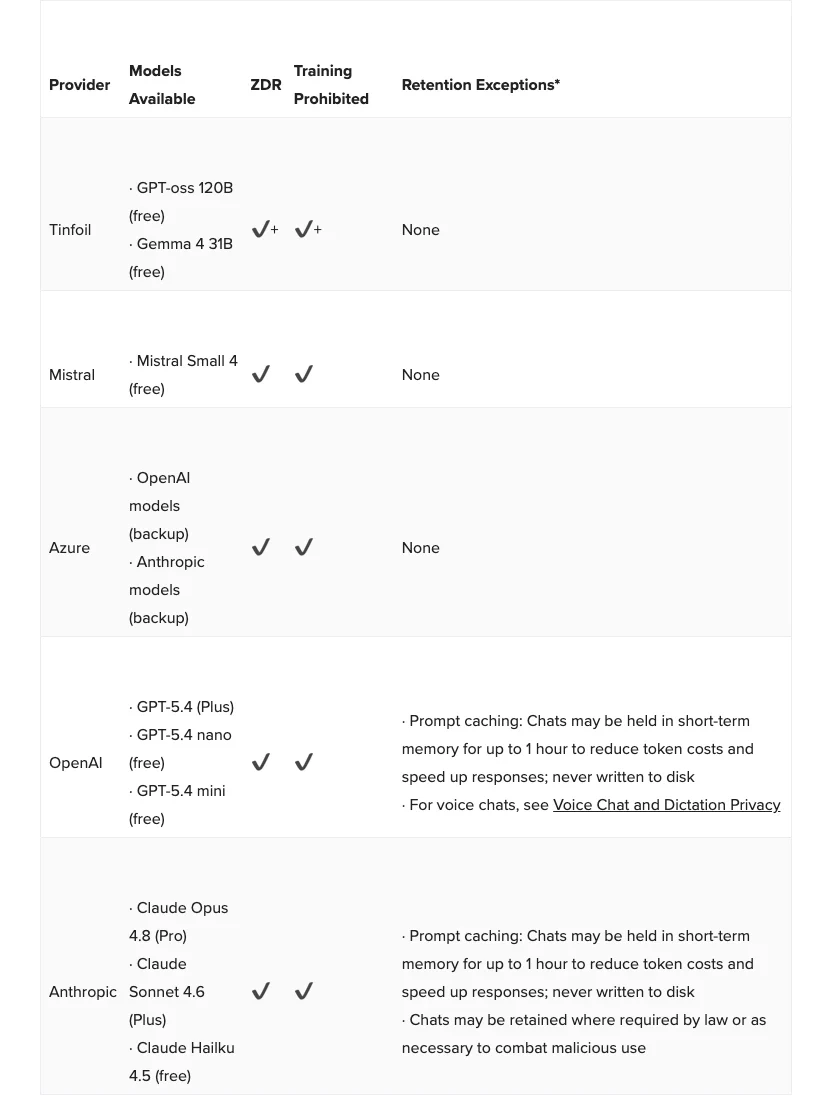
Its documentation is unusually specific about the boundary. Tinfoil and Mistral rows list no retention exceptions. OpenAI and Anthropic rows permit prompt caching in short-term memory for up to one hour, and Anthropic may retain chats where required by law or to combat malicious use. Uploaded images and files also pass through separate abuse scanning. That transparency improves the score; it does not erase the exposure.
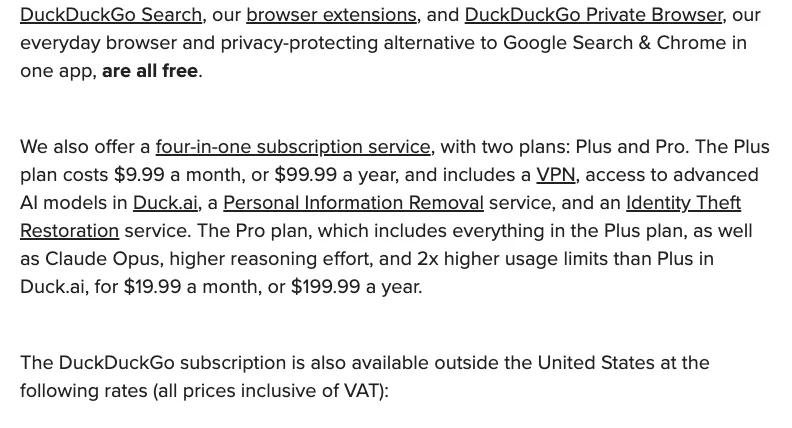
The paid plan is a bundle, not a pure chatbot subscription. Plus is $9.99 monthly or $99.99 yearly and adds advanced models alongside a VPN, personal information removal, and identity restoration. Pro is $19.99 monthly or $199.99 yearly and adds Claude Opus, higher reasoning, and twice the Plus usage limits. Exact daily and weekly quotas remain unpublished.
Duck.ai combines a no-account free path with strong documentation of which providers process requests and where retention exceptions still exist.
Skip it if third-party model processing is outside your threat model or you want exact published quotas before paying.
Duck.ai nearly wins because no-account access and exceptional policy detail reduce guesswork, but provider-specific processing remains a wider exposure than Lumo's focused storage model.
- No account is required for the free service
- Identifying metadata is removed before provider processing
- Provider, model, and retention exceptions are documented in one table
- Paid bundle can replace separate VPN and data-removal spending for the right buyer
- OpenAI and Anthropic rows disclose short-term prompt-caching exceptions
- Uploaded files and images require separate abuse scanning
- Exact daily and weekly usage quotas are not published
- The four-in-one bundle is inefficient if you only want AI model access
3. Venice AI: best private creative and API platform
Venice is the broadest product here. Pro includes all models, unlimited text prompts, 1,000 images per day, API access, character creation, and a small monthly credit allocation. Pro+ and Max increase credit banking, video access, API limits, and support. The current monthly cards show $18, $68, and $200, with a 10% annual discount.
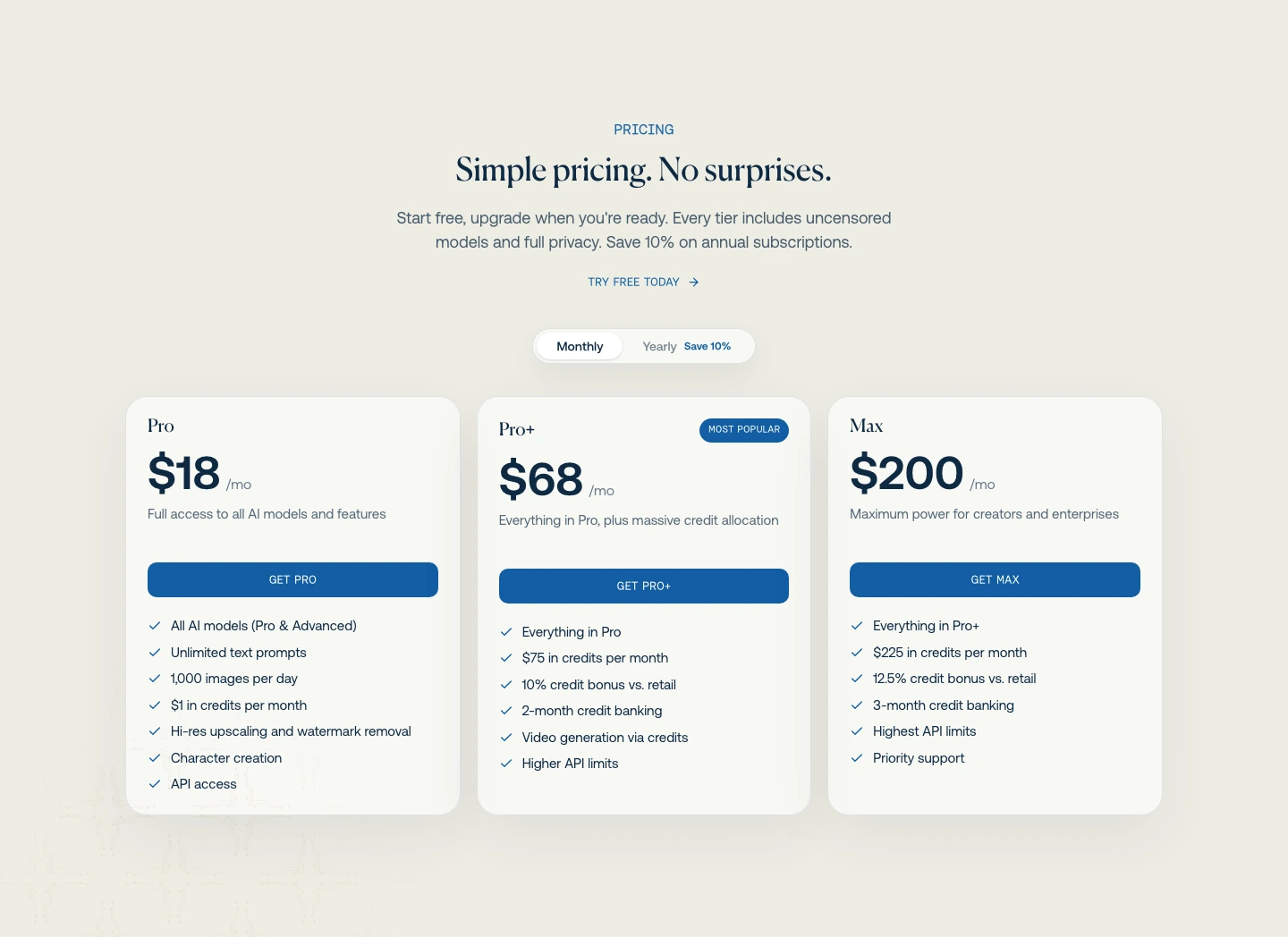
Its privacy design is more capable and more demanding. An anonymized third-party model is not the same thing as a self-hosted private model, TEE inference, or end-to-end encrypted mode. Venice now labels those differences, which is useful. The buyer still has to check the selected model instead of assuming the platform applies its strongest mode everywhere.
That complexity is the reason Venice ranks third for an ordinary private-chat buyer: capability rises, but so does the number of model, mode, and credit decisions. It moves to first for a narrower power user whose job includes images, video, audio, API calls, many open models, or fewer content restrictions, because neither Lumo nor Duck.ai is an equivalent substitute.
Venice exposes four privacy modes and combines chat with image, video, audio, code, search, and an OpenAI-compatible API.
Skip it if you want one simple privacy promise, exact low-cost chat value, or a conventional encrypted history workflow.
Venice ranks third for the default private-chat buyer because mode and credit complexity add decisions, while its breadth makes it the strongest specialist for creative and API workflows.
- Four privacy modes expose meaningful architecture differences
- Broad text, image, video, audio, code, search, and API scope
- Pro includes unlimited text prompts and a large daily image allowance
- Official referral program gives both sides API credits after a qualifying Pro upgrade
- Privacy protection varies by the model and mode selected
- Pro Plus and Max value depends on understanding the credit layer
- The broad product surface is more complex than a focused private chatbot
- Referral rewards are service credits, not cash earnings
Also considered: Brave Leo, local models, and enterprise AI
Brave Leo is the obvious omitted browser-native option. It belongs in a private browser decision because the assistant is tied to Brave's broader browsing surface; adding it here would blur the three distinct hosted-chat architectures. A local model is the stronger answer when no cloud operator may process the prompt at all, but local hardware, model setup, updates, and output quality form a separate buying guide.
Enterprise AI products with contractual retention controls can be appropriate for approved company data. They should not be inferred from consumer plan pages. If procurement, audit logs, data residency, single sign-on, or a data processing agreement is mandatory, compare business contracts rather than treating any consumer privacy badge as approval.
How to choose: start with the failure you need to prevent
Choose Lumo when the unacceptable failure is the service operator reading saved history. Choose Duck.ai when the unacceptable failure is tying a casual prompt history to an account, but third-party model processing under documented agreements is acceptable. Choose Venice when the failure is losing model and media flexibility, and you are willing to inspect the privacy badge for every workflow.
Then run the boring checks. Confirm the model, privacy mode, file-handling rule, history setting, reset window, billing period, and deletion path before placing sensitive work in the product. “No training” answers only one question. It does not automatically answer storage, transient caching, human access, legal retention, or account recovery.
Proton Lumo wins this evidence-led comparison for readers who need encrypted, searchable history. Duck.ai is the cleaner free/no-account gateway, while Venice is the better private creative and API platform.
Final verdict: match the privacy architecture to the prompt
Start with Proton Lumo when confidential saved history is the buying reason. Its zero-access storage model and focused paid plan make the privacy story easier to explain and maintain.
Use Duck.ai when no-account access, multiple models, and unusually clear provider disclosures matter most. Its provider exceptions are not a hidden gotcha; they are the boundary you should read before sending a sensitive prompt.
Choose Venice AI when the workflow extends beyond ordinary chat into open models, images, video, audio, API calls, or reduced content restrictions. Check the active privacy mode rather than carrying the strongest Venice claim across every model.
None of these recommendations authorizes sensitive organizational data. When the consequence of disclosure is legal, medical, financial, professional, or personal harm, the right first step is an approved data policy, not a pricing page.
Frequently Asked Questions
Ready to check Proton Lumo?
Use the verified route if the trade-offs still fit. If not, jump back to the summary and compare the alternatives.
Security and privacy editor focused on evidence-led buying guides. Reads official documentation, audit notes, privacy policies, recovery limits, and support pages before turning security claims into practical recommendations.
Sarah starts by locating the evidence boundary, then ranks security and privacy tools by audit and policy scope, recovery design, trust boundaries, residual risk, and what a cautious buyer can verify.
Related Articles
Malwarebytes vs Bitdefender vs Norton
Paid antivirus decision guide
Malwarebytes, Bitdefender, Norton, and Microsoft Defender compared by paid antivirus value, real-time protection, renewal risk, bundle scope, and lab evidence.

Spam Call Blocker Apps That Won't Nuke Real Calls
4 spam call blocker paths compared by scam protection, real-call safety, platform fit, verified pricing, and privacy friction
Hiya, Phone by Google, Truecaller, and RoboKiller compared by spam blocking, scam-call alerts, official pricing, privacy labels, and real-call risk.