

The MiCA deadline changed the first question an EU crypto buyer should ask. It is no longer “Which exchange has the best app?” It is “Which legal entity will hold my account, and is that entity authorised for the service I need?” If the product is a stock-linked token rather than spot crypto, use our EU tokenized-stock platform comparison, because the wrapper and shareholder rights are different.
Kraken is my default pick for an EEA holder after the July 1, 2026 transition deadline. The case for Kraken for EEA users is unusually specific: named Irish entities, registration numbers, authorised services, passporting scope, and a long regional restriction list. Coinbase remains the easier first euro purchase. Crypto.com makes more sense when its app and card ecosystem are part of the decision.
That is not a safety guarantee. MiCA authorisation does not insure a crypto balance, remove market volatility, promise that every token is supported, or make every service offered by a global group regulated. The logo is not the licence. The contracting entity and service scope are what count.
This is an evidence-led comparison. I checked current regulator notices, provider entity disclosures, EEA restrictions, and public fee pages on August 13, 2026. I did not open accounts, complete KYC, fund with euros, preview identical orders, test Travel Rule prompts, withdraw coins, use cards or staking, contact support, or close an account.
If you need a global shortlist, use our best crypto exchanges guide. For the broader Kraken and Coinbase custody-and-fee decision, read the Kraken vs Coinbase comparison. This page owns the narrower post-deadline EEA job: verify the entity, check regional restrictions, then choose a transfer path.
-
#1 KrakenBest EEA default: the clearest public entity, service, registration, and restriction disclosure
-
#2 CoinbaseBest beginner euro ramp: simple consumer flow, but complete Advanced fees require sign-in
-
#3 Crypto.comBest app and card ecosystem: useful all-in-one option, but App and Exchange costs differ
What the July 1 MiCA deadline actually means
MiCA is the EU’s Markets in Crypto-Assets framework. National transition periods let some previously registered providers continue operating while the new authorisation regime came into force. Those transition periods ended across EU member states on July 1, 2026.
The Central Bank of Ireland’s current consumer warning says providers serving EU consumers must hold a MiCA licence after that date. It tells consumers to verify the provider in the ESMA register. If an entity is not authorised and the consumer wants MiCA safeguards, the regulator names two practical options: transfer to an authorised crypto-asset service provider or to a self-hosted wallet.
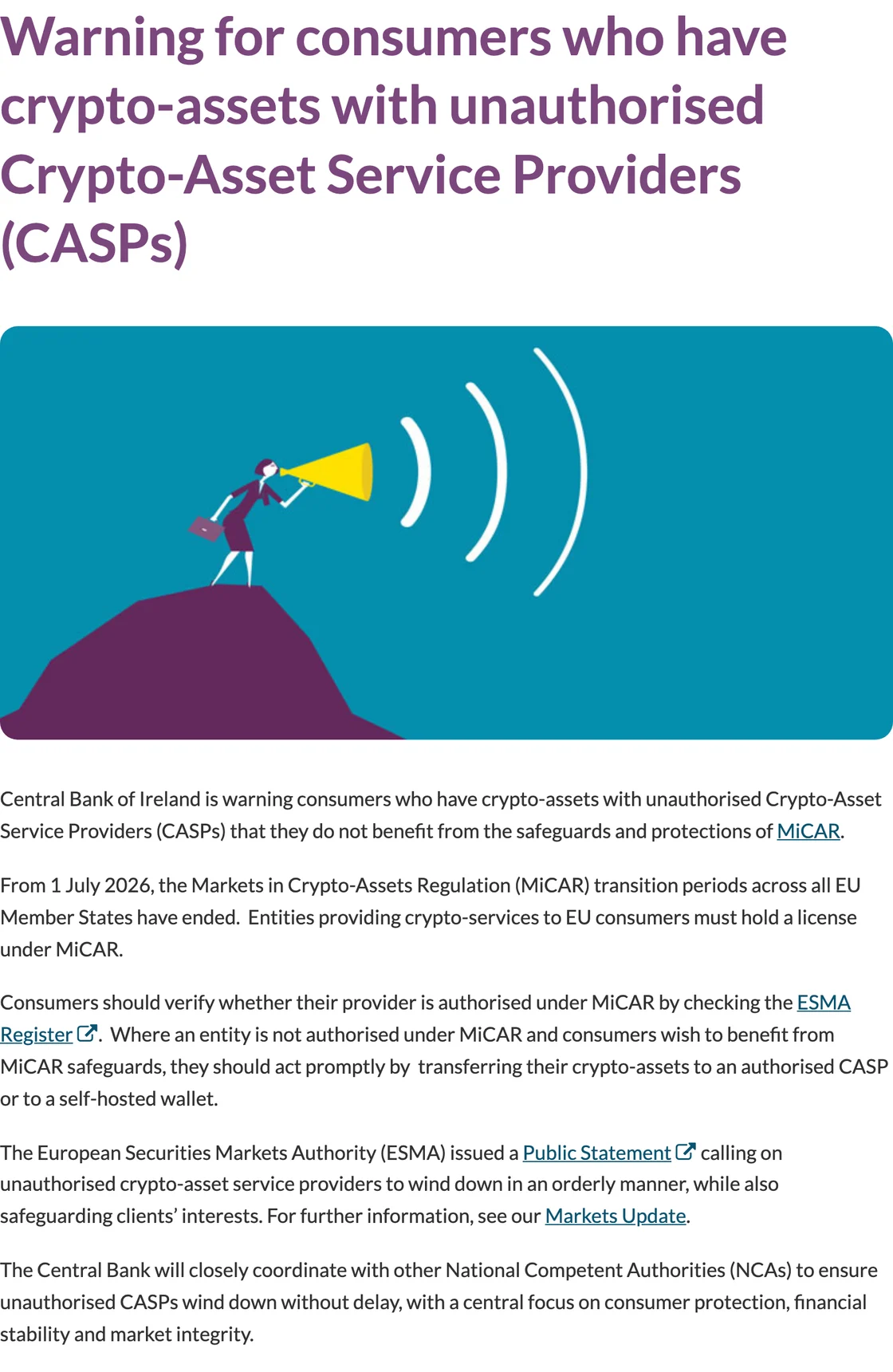
The warning is important for what it does not say. It does not tell every crypto holder to move immediately. It does not say an authorised provider is free from operational failure. And it does not turn a self-hosted wallet into an easy option. Self-custody removes exchange custody from the equation, then puts address verification, network choice, private keys, and recovery entirely on the holder.
Kraken vs Coinbase vs Crypto.com in the EEA
| Feature | Kraken | Coinbase | Crypto.com |
|---|---|---|---|
| Best job | Regulated spot exchange for a custody-aware holder | Simplest first euro purchase | App, Exchange, and card ecosystem |
| MiCA entity signal | Irish CASP entities with CBI registration numbers and EEA passporting | Coinbase Luxembourg S.A. under CSSF authorisation | Malta entity licensed by MFSA for EEA passporting |
| Public cost evidence | Entry tier published at 0.40% maker / 0.80% taker | Advanced is tiered; complete schedule requires sign-in | Exchange Level 1 starts at 0.25% maker / 0.50% taker |
| Regional catch | Long EEA asset and reward restriction list | EEA entity and execution consent need reading | App and Exchange are different cost surfaces |
| Exit fit | Strong buy-to-self-custody workflow | Good ramp if the buyer plans the withdrawal | Useful, but verify the exact product and network |
| Skip if | Your asset or reward product is restricted in the EEA | You need the full fee table before creating an account | You want one simple spot-only fee surface |
| Action | Check Kraken | Check Coinbase | Check Crypto.com |
How I ranked the three exchanges
I gave EU Regulatory Clarity 30% of the score because eligibility comes before convenience. Product Fit and Cost Clarity receive 20% each. Exit & Custody and Beginner Value receive 15% each. Every exchange is scored on the same five criteria.
This order is deliberately not “cheapest fee wins.” A low trading fee is useless if the destination does not support the exact asset or network. A licence headline is incomplete if the account belongs to a different entity. And a clean app is expensive if it keeps a buyer in simple-buy spread when an order book would do the same job.
Kraken wins because it exposes more of the verification work before signup. Coinbase’s strongest counterargument is operational simplicity: a nervous beginner may avoid a costly funding or address mistake in the easier app. Crypto.com’s strongest case is consolidation for someone who genuinely uses the app and card, not just spot execution.
Four problems MiCA authorisation does not standardise
Asset availability is still local. A provider can be authorised and still restrict a stablecoin, privacy coin, reward programme, or staking service. The destination check must therefore happen at asset level, not exchange level. Search the current restriction page and confirm the deposit screen before initiating a withdrawal from the old provider.
The visible fee may describe the wrong product. Kraken’s order-book tier, Coinbase’s simple-buy quote, Coinbase Advanced, the Crypto.com App, and the Crypto.com Exchange are not interchangeable surfaces. Compare one realistic euro-to-asset route from funding through withdrawal. A cheaper maker rate does not help a buyer who always uses an instant-buy flow, and a clean purchase preview does not reveal a later network fee.
Transfer reviews are not identical. Travel Rule information can depend on the counterparty, transaction, jurisdiction, and whether the destination is another provider or a wallet you control. A delay reported in a forum is a question to investigate, not a failure rate. Before a time-sensitive transfer, check what beneficiary data the sending and receiving platforms require and whether self-hosted-wallet ownership must be confirmed.
Recovery remains your problem in self-custody. A self-hosted wallet removes the exchange’s account-recovery team from the critical path. That is the point, but it also means a lost seed phrase, wrong network, compromised address, or untested inheritance plan can be final. Do not let regulatory urgency push you into a wallet setup you have not verified.
These gaps explain why the ranking begins with regulatory clarity and ends with a transfer checklist. MiCA narrows the provider-risk question. It does not collapse product, cost, and custody into one green badge.
1. Kraken: best default for a custody-aware EEA holder
Kraken’s advantage is not a generic “regulated” badge. Its current licensing page separates the jobs across named entities. Payward Ireland Limited is listed as an electronic money institution. Payward Europe Solutions Limited is listed as a MiCA crypto-asset service provider for custody, exchange, execution, transfer, and other services. Payward Global Solutions Limited is listed as the CASP operating the trading platform.
The same page publishes Central Bank of Ireland registration numbers and says the licences are passported to EEA countries. It then lists regional restrictions. When checked, the list included USDT and XMR among assets EEA clients could not deposit or trade, while some starred assets were restricted only in Germany. USDG Rewards and Babylon Bitcoin Staking were unavailable, and Opt-in Rewards were limited to Bitcoin.
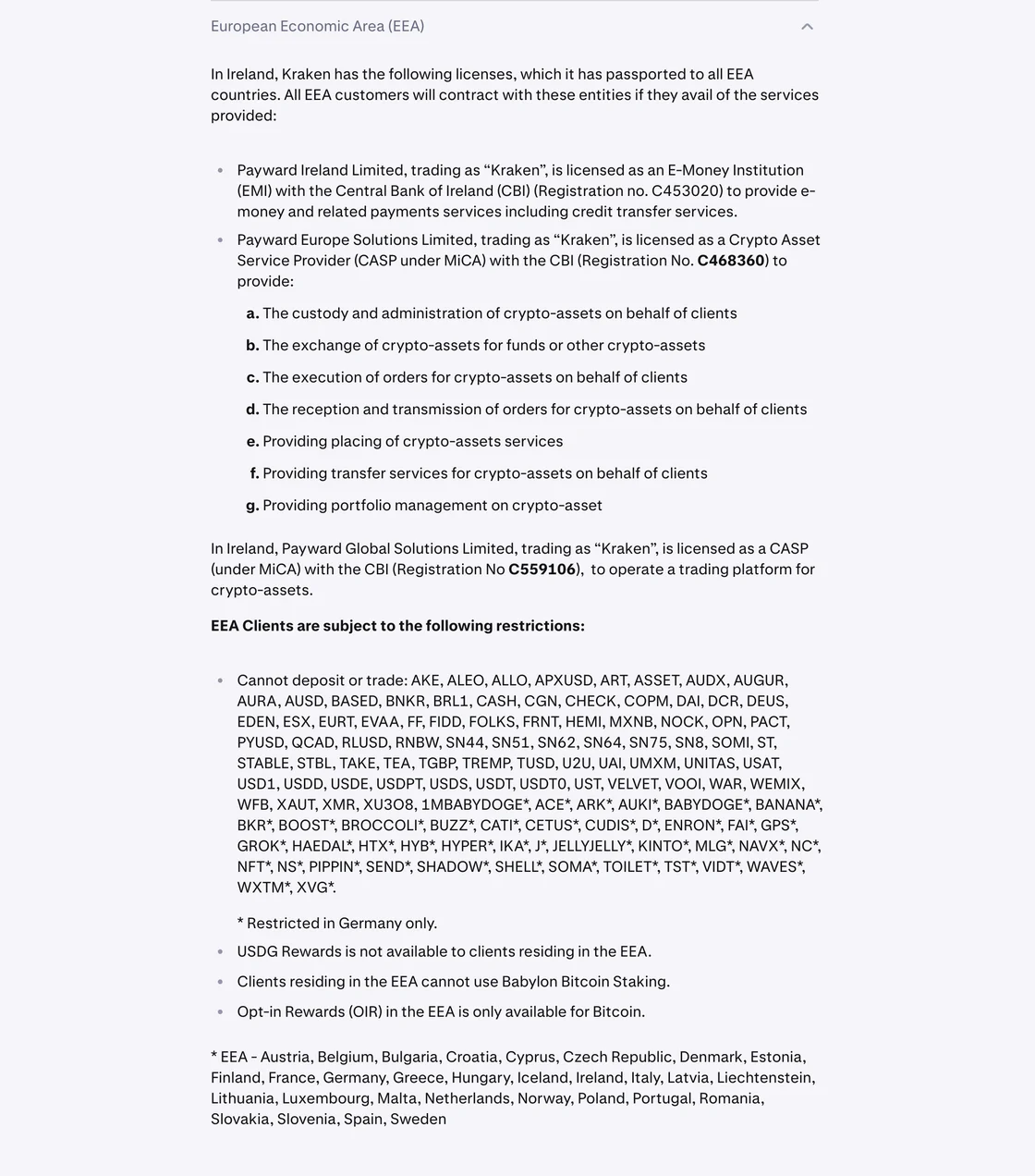
That restriction list is a feature of the comparison, not a footnote. If you hold a listed asset, Kraken can be the clearest regulated choice and still be the wrong destination. Check the current page again immediately before moving anything; asset treatment is volatile.
Kraken’s published entry spot tier is 0.40% maker and 0.80% taker. A €1,000 taker order is about €8 at that percentage before funding, spread on another product surface, or withdrawal costs. That arithmetic is not an account quote. The fee is not market-leading, but the public table is easier to inspect than a sign-in-only schedule.
Kraken gives an EEA buyer a concrete pre-signup trail from legal entity and registration number to authorised services and current regional restrictions.
Anyone whose exact asset, reward, or staking product is restricted, or a frequent small trader who cannot justify the published entry fee.
Kraken leads on entity and restriction clarity plus the exchange-to-wallet path. Its long EEA restriction list and expensive entry tier prevent a runaway score.
- Names the Irish EMI and MiCA CASP entities that perform different services
- Publishes CBI registration numbers and EEA passporting scope
- Lists current regional asset, reward, and staking restrictions
- Public entry-tier fee evidence is visible before account creation
- Strong fit for a buyer planning to withdraw long-term holdings
- Current EEA restrictions include USDT, XMR, and many other assets
- The 0.80% entry taker rate is expensive for frequent small orders
- Multiple entities still require the buyer to match the service to the contract
- Not as simple as Coinbase for a first-ever euro purchase
2. Coinbase: best first euro ramp
Coinbase is the easiest recommendation to understand and the hardest one to price from the outside. Its consumer app is familiar, the bank-to-buy path is approachable, and a beginner can see the final transaction preview before confirming. That reduction in first-week friction has real value.
For affected EEA customers, Coinbase’s official MiCA service-change page names Coinbase Luxembourg S.A. and its Luxembourg regulator, CSSF. It also explains that the user agreement moves to the Luxembourg entity for crypto services. Croatian customers were given an October 23, 2025 effective date in that migration schedule.
The detail to read is execution. Coinbase says EEA customers consent to Coinbase Luxembourg trading outside European platforms, including Coinbase Exchange, as part of order execution. That does not make the service unauthorised. It does mean “EU account” is not a complete description of every execution step.
Cost clarity is the weakness. Coinbase Advanced uses maker/taker pricing and no simple-buy spread, but the complete current fee schedule requires sign-in. The basic Coinbase quote can include fees and spread in the displayed price. Compare the actual preview, not a third-party percentage copied from an old table.
Coinbase makes the first euro purchase easier while publishing a specific Luxembourg MiCA migration and execution disclosure for EEA customers.
Buyers who need the complete fee schedule before signup, already understand order books, or want the most explicit public regional restriction page.
Coinbase nearly catches Kraken through beginner value and product fit. Sign-in-only Advanced fees and the extra execution-consent detail reduce cost and regulatory clarity.
- Very strong first-purchase usability for an EEA beginner
- Official page names Coinbase Luxembourg and the CSSF authorisation
- Transaction preview gives the buyer a final checkpoint before confirmation
- Coinbase Advanced avoids the simple-buy spread by using an order book
- Good bridge for buyers who will later move to a more disciplined workflow
- Complete Advanced fee tiers require sign-in
- Simple Coinbase buys can include spread in the quoted price
- EEA execution consent deserves reading before account migration or funding
- The easiest interface can become an expensive permanent habit
3. Crypto.com: best when the ecosystem is the point
Crypto.com is the situational third choice, not a weak one. It combines a consumer app, separate Exchange, card, and other product surfaces. That can reduce app switching for a buyer who uses the whole ecosystem. It also makes a clean fee comparison harder because the Exchange table does not automatically describe the consumer app quote.
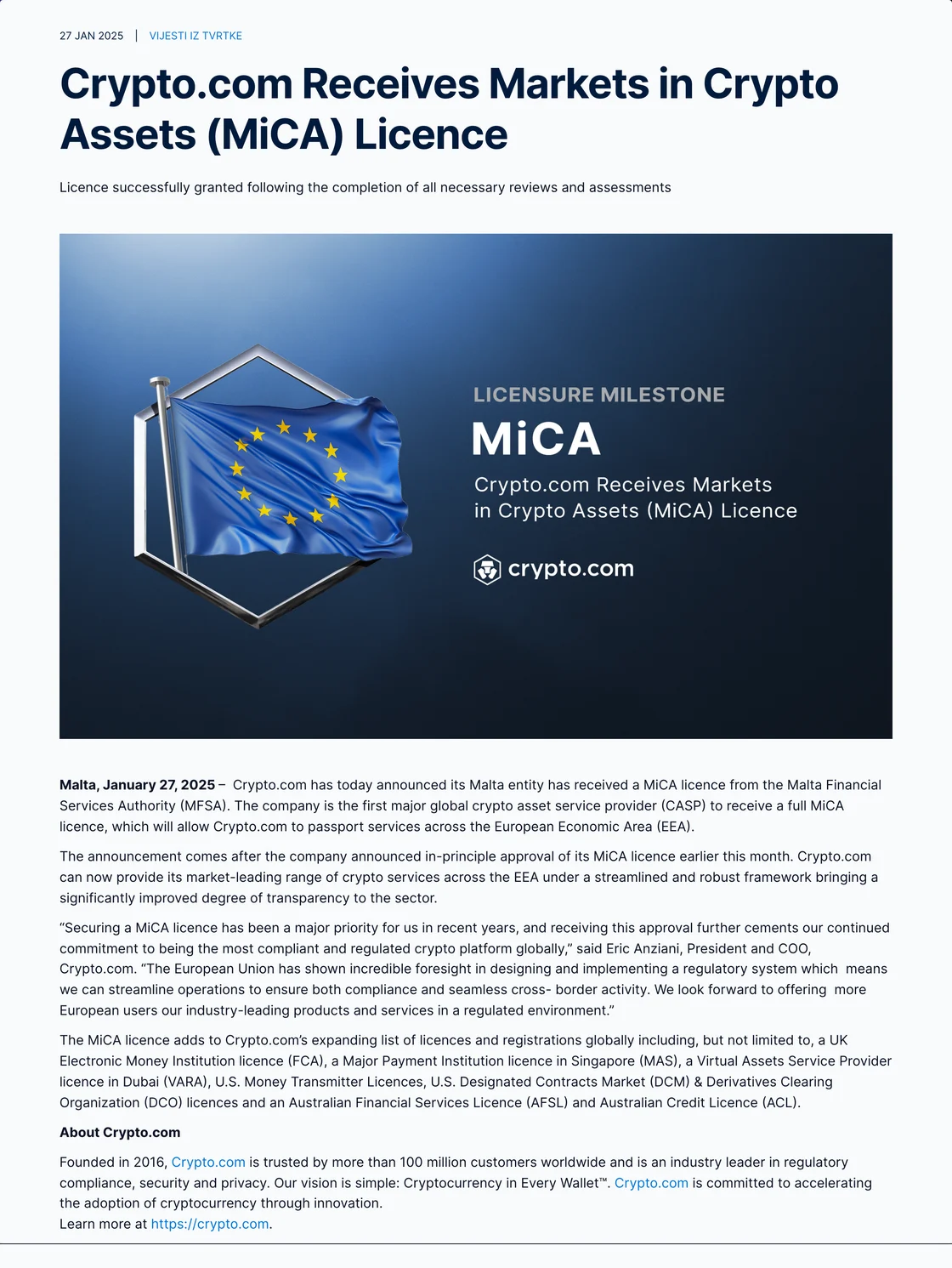
Crypto.com’s official announcement says its Malta entity received a full MiCA licence from the Malta Financial Services Authority and can passport services across the EEA. The licence is a concrete entity-and-regulator signal. It is not proof that every card, reward, staking, app, or exchange feature has identical availability in every country.
The Crypto.com Exchange Level 1 spot table starts at 0.25% maker and 0.50% taker below $10,000 in 30-day spot volume without a CRO balance. That looks cheaper than Kraken’s entry tier. But only use the number when the Exchange is the route you will actually trade through. A simple purchase in the app can have different economics.
Crypto.com pairs a named Malta MiCA licence with an unusually broad consumer ecosystem and a competitive published Exchange entry tier.
Buyers who want one spot-only product surface or might mistake the Exchange fee table for the consumer app's final quote.
Crypto.com is credible and useful, but the app, Exchange, card, and reward layers create more product and cost verification than the narrower decision requires.
- Official announcement names the Malta entity and MFSA licence
- Licence can be passported across the EEA
- Strong fit when the app and card ecosystem are genuinely useful
- Published Exchange Level 1 fee is competitive with Kraken entry pricing
- One account can cover more jobs than a spot-only exchange
- App and Exchange are different cost and feature surfaces
- Card, reward, and product availability remains country-specific
- A broad ecosystem creates more terms to verify before funding
- Less clean for a buyer who only wants spot execution and withdrawal
Which exchange should you choose?
Choose Kraken for a normal buy-and-withdraw routine. It is the best fit when you want a public order-book fee, can read a restriction list, and intend to move long-term holdings to a wallet. The extra entity detail helps before signup, while the published restrictions reduce the risk of discovering an unsupported asset only after a transfer starts.
Choose Coinbase when operational simplicity is the larger risk. A first-time buyer who is likely to misread an order book or abandon setup may rationally accept less public fee certainty. Use the consumer flow for the first safe purchase if necessary, then compare Coinbase Advanced once limit orders and transaction previews make sense.
Choose Crypto.com when consolidation has measurable value. If you will actually use the app, card, and Exchange, one ecosystem may beat a slightly cleaner spot-only decision. Write down which surface handles each job and which fee applies. If you only need euro funding, one spot order, and one withdrawal, that breadth is more complexity than benefit.
Choose none of them until the asset check passes. A fourth provider may be better when your exact token, network, home country, or funding method is unsupported here. OKX Europe and Bitpanda are credible regional alternatives worth investigating; they were not scored because this comparison stays with the three strongest existing GDT commercial routes. Exclusion from the table is not a claim that another provider lacks authorisation.
How to choose: the five-step verify-before-transfer checklist
1. Identify the exact legal entity. Read the current user agreement, account settings, and legal footer. Do not infer the entity from the brand’s home page or a licence announcement for another subsidiary.
2. Check the ESMA register. Match the company name, home member state, and authorised services. A similar company name is not enough. If the register and provider disclosure disagree, stop and resolve that mismatch before funding.
3. Verify the asset and network at the destination. Confirm that deposits are enabled for the exact asset and chain. “Supports USDC” does not prove support for the network you plan to use. An authorised destination can still reject the asset or network.
4. Read the transfer and ownership prompts. Travel Rule checks may ask for counterparty or self-hosted-wallet information. Community reports are useful for discovering that question, but not for predicting your delay. Use the provider’s live prompts and current help documentation.
5. Send a small test first. Save the address, network, amount, transaction ID, and destination confirmation. Only move the remainder after the test arrives. If self-custody is the destination, set up a hardware wallet and durable seed phrase backup before the exchange deadline becomes your recovery deadline.
This is not a reason to panic-sell. The regulator-supported action is orderly verification and transfer. Selling can create a market decision and a taxable event when the actual problem is custody or provider authorisation. For recordkeeping after transfers, compare the workflow in our crypto tax software guide.
Final verdict: verify the entity, then choose the workflow
Pick Kraken if you want the clearest public EEA entity and restriction trail plus a disciplined route toward self-custody. Check the current restricted-asset list before moving anything; the winner can still be wrong for your holdings.
Pick Coinbase if the easiest first euro purchase matters more than seeing a complete fee table before signup. Use the preview, understand whether the transaction is simple buy or Advanced, and decide the withdrawal plan before convenience becomes inertia.
Pick Crypto.com if the app and card ecosystem are part of the buyer job. Compare the fee for the product you will actually use, not the most attractive fee table elsewhere in the ecosystem.
The durable rule is simple: entity first, asset and network second, total cost third. A licence can qualify the provider for the decision. It cannot finish the decision for you.
Kraken wins through unusually concrete entity, registration, service, and restriction evidence. Coinbase is better for first-week simplicity, while Crypto.com is better when its wider ecosystem is the point.
Try freeMiCA crypto exchange FAQ
Ready to check Kraken for EEA users?
Use the verified route if the trade-offs still fit. If not, jump back to the summary and compare the alternatives.
Crypto and productivity editor focused on cost, custody risk, setup friction, exports, fees, and workflow drag. Prioritizes verifiable numbers and clear skip criteria over hype.
Lucas starts with total operating cost, then ranks tools by setup and recurring friction, custody or export, reversibility, and whether the decision still makes sense when the exit path is included.
Related Articles

Best Tokenized Stock Platforms for EU Users
EU stock-token platforms compared by legal wrapper, total cost clarity, shareholder rights, trading hours, and self-custody exit
Kraken xStocks, Robinhood Classic Stock Tokens, and Crypto.com compared for EU users by ownership, fees, rights, market hours, and wallet withdrawal.
Stablecoin Cards Compared: Rewards, FX, and Custody Traps
Stablecoin-funded payment cards compared by everyday spend cost, reward caps, FX and conversion fees, custody model, region availability, and tax friction
Coinbase Card, Bybit Card, Crypto.com Prepaid Card, and Nexo Card compared by stablecoin spend cost, rewards, FX fees, custody, and region fit.